By Carol Morello and Anthony Faiola, Washington Post
SEVASTOPOL, Ukraine — The Crimean parliament sharply escalated the stakes Thursday in a standoff over the region’s future, voting to join the Russian Federation, calling a referendum in 10 days to validate its decision and vowing to nationalize Ukrainian state industries.
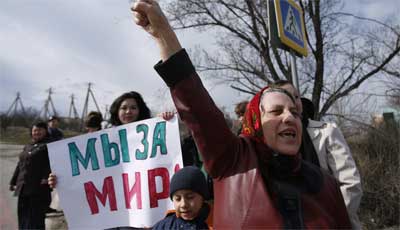
Pro-Ukrainian demonstrators shout slogans during a rally in Simferopol, Ukraine. The banner reads “We are for peace.” Crimea’s vice premier, Rustam Temirgaliev, said on Thursday a referendum on the region’s status would take place on March 16, RIA news agency reported on Thursday. (David Mdzinarishvili/Reuters)
In Washington, President Obama condemned the moves Thursday, saying the referendum violates both the Ukrainian constitution and international law. He also called for international monitors to be allowed into all of Ukraine, including Crimea, to ensure that people’s rights are being respected, including the rights of ethnic Russians.
He spoke after Crimea, currently an autonomous part of Ukraine, announced not only the referendum but the formation of new ministries of energy, information, interior and pensions separate and distinct from the central government in Kiev. The moves were quickly disavowed by Ukraine’s new interim government as unconstitutional, illegal and treasonous.
But the looming showdown in the majority ethnic Russian region — where forces loyal to Moscow are blockading Ukrainian military barracks and warships — underscored the growing challenge facing the new pro-Western government in Kiev as it tries to regain its lost territorial integrity.
The March 16 referendum would also give Crimean voters the option of remaining part of Ukraine, but with enhanced local powers.
“This is our response to the disorder and lawlessness in Kiev,” Sergei Shuvainikov, a member of the Crimean legislature, said Thursday. “We will decide our future ourselves.”
The Obama administration moved Thursday to sanction unspecified individuals who have undermined democracy in Ukraine, threatened the nation’s security or looted national assets. An executive order signed by President Obama freezes assets and blocks U.S. visas for the affected individuals, who administration officials said would include Ukrainians, as well as Russians involved in the military intervention in Crimea.
European leaders also sounded alarms, denouncing the Crimean referendum plans as illegal.
“This has nothing to do with democracy; that is obvious to everyone,” German Chancellor Angela Merkel told reporters in Brussels, site of an emergency summit called by the 28-member European Union to decide whether to impose sanctions on Russia.
Read the full story by Carol Morello and Anthony Faiola from Washington Post.