By DAVID W. LLOYD, New York Times
Waist-deep in cool river water on a sweltering June afternoon, we waded toward the entrance of the immense Hang En cave in the Quang Binh province of central Vietnam. There, we donned our hard hats and headlamps and silently entered single file, darkness enveloping us, just the light of our flashlights illuminating our path. A few hundred feet in, we reached a mountain of boulders. As we scrambled up, the light became more intense as we gained height. On reaching the summit we were stopped dead in our tracks by the view before us — the cave’s gigantic main cavern.
Cavers enter Hang En, a cave tunneled out by the Rao Thuong River. (Photo by Carsten Peter/National Geographic/Getty Images)
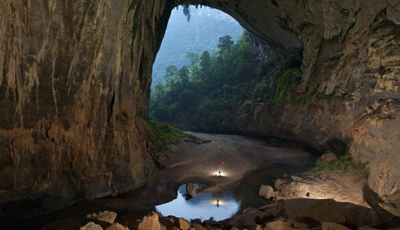
At 300 feet in height and 600 feet across, the cavern is big enough to fit a Boeing 747 with room to spare. The space was flooded with rays of natural light coming in from an arch high above us. The beams of light illuminated a yellow sand beach hundreds of feet below, surrounding a calm turquoise pool.
A team of porters who had gone ahead of us were already down on the beach, some pitching our tents for the night, others keeping a fire burning ready to cook dinner. As flames flickered, catching on the light breeze being drawn through the cave, smoke swirled upward in the musky, dank air.
Two nights before I had been having dinner with Howard Limbert, a gregarious 57-year-old cave expert who left his job in England as a biomedical scientist in 2012 to devote his life to exploring the caves of Vietnam. Mr. Limbert spoke with infectious enthusiasm about his many research expeditions during the 1990s to map and measure Hang En and the other caves in the region, using laser technology. He told me, between deep drags on a Vietnamese-brand cigarette, that by trekking to Hang En, I would have one of the most exciting adventures of my life. As I stood looking out over the vast, otherworldly space before me and reflecting on the hike to reach it, his words rang true
In this jungle region of central Vietnam, the Hang En cave is one in a series of mind-blowing caverns discovered by Mr. Limbert, his wife, Deb, 54, also a caver, and their colleagues from the British Cave Research Association. The most enormous cave here is Son Doong Cave, which ranks — alongside Miao Room in China and Sarawak Chamber and Deer Cave in Borneo — as one of the world’s largest caves. Son Doong last year for the first time became accessible to a limited number of tourists, thanks to Oxalis, the most established and reputable company running tours in the region’s caves.
In Son Doong’s vast caverns, forests of 100-foot-tall trees thrive in spaces big enough to accommodate 40-story skyscrapers. Colossal 260-foot stalactites, not to mention monkeys, hornbills and flying foxes, are also found in Son Doong’s surreal habitat, first fully explored in 2009. However, Son Doong, at $3,000 for a six-day trek into the deep innards of the cave, was far out of my price range and, in any case, sold out. Only 250 total spots were available for 2014, but slightly more will be offered in 2015, with bookings beginning in November.
However, other remarkable caves are nearby and much more affordable. There is the Hang Ken cave with its waterfalls spilling into large lagoons, shimmering goldlike mineral deposits and soaring columns created over thousands of years when stalactites hanging from the cave roof met stalagmite formations building from the cave floor. I decided on the larger and more dramatic Hang En cave on Mr. Limbert’s strong recommendation as it offered the chance to camp inside the colossal main cavern, and would be a wildly adventurous journey.
The Hang En tour involves a difficult daylong trek over limestone mountain paths and along riverbeds to the remote indigenous village of Ban Doong. As a Hanoi-based travel journalist and photographer who has lived in the region for nearly four years, I relished the idea of discovering something fresh and different. And as a competitive cyclist and mountain runner, I liked the muscle-burning aspect.
The expedition began in Phong Nha, a sleepy community of 1,000 people about six miles from the start of our trek. The town has acted as a base for cave-visiting for the past few years, with numbers swelling after the 2011 opening of the easily accessible Paradise Cave, popular with Vietnamese tourists as it can be reached by boat with no trekking required. Before the cave tourists arrived, the town was poor, with income mainly derived from farming, fishing and hunting.
The Paradise Cave and the more adventurous cave expeditions have turned this former tourist backwater, which lies 12 hours by train from Hanoi, into a bucket-list destination for intrepid travelers, with a choice of three caving adventures now on offer via Oxalis Adventure Tours: the Son Doong cave trek; treks to the Tu Lan river cave system that includes the Hang Ken cave at a cost of $260; and the Hang En trek that I had opted for, at $275.
Mr. Limbert and I had met for dinner at his favorite Phong Nha restaurant, Quan An Vung Hue. Sparsely decorated, it is hidden behind the small town’s narrow main street. Soon, an array of his culinary recommendations lay before us — a bowl overflowing with marinated, grilled ribs, a plate of crunchy greens sautéed with garlic, a dish of beef stir-fried with pineapple, and the obligatory mound of rice. Grazing on our feast, Mr. Limbert recalled the four full days it had taken him in the early 1990s to complete what had been for me only an overnight journey from Hanoi.
Clearly in his element, he leafed through photographs as he recalled those early days. In one, his wife, Deb, stands on a rutted stone track, cradling a rusted machine gun in her hands. “That was in 1990,” he said. “You almost couldn’t put your foot down without treading on remnants of war. There were guns, bullet shells and bomb casings everywhere.”
After dinner, we cycled toward my guesthouse along pitch-black streets devoid of streetlights. The chatter of families emanated from the small, one-story homes on the river’s edge, some made of concrete, others little more than shacks, in which several generations live crammed together. Otherwise, the only noise was the cacophony of buzzing and whirring insects from the riverbank. As we rode, a small boy appeared from nowhere and hitched a ride on my bike’s rear rack. “That’s normal here — bicycles are like a free informal taxi service,” Mr. Limbert said, smiling.
We arrived at Ho Khanh’s Homestay, owned by Mr. Ho Khanh himself, now a local celebrity who is credited with discovering the Son Doong entrance in 1990 while on a hunting trip. He later led Mr. Limbert and other members of the initial cave exploration team to Son Doong. Never afraid of a superlative, it was then that Mr. Limbert made his bold claim, bidding me the good-night promise that the next day I would be doing one of the “best, most amazing things it’s possible to do in Vietnam” — the Hang En trek.
The next morning I arrived at the Oxalis Adventure Tours office and met my fellow cavers — seven Australian men and women in their mid-20s, some on vacation, some on extended backpacking trips. After being kitted out in Cambodian army boots and given waterproof backpacks and water bottles, we set off by van for the Phong Nha-Ke Bang National Park, a few miles from town.
Read the full article HERE.