By Faine Greenwood, Peninsula Press
At health fairs, community clinics and even 5K fun runs, preventative care is a refrain that Bay Area Asian Americans hear a lot these days.
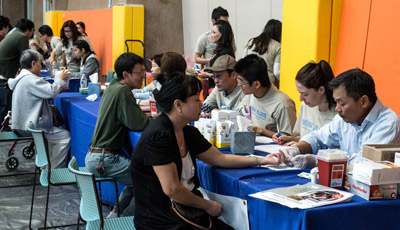
A Vietnamese community health fair in San Jose in early October screened people for diabetes. (Faine Greenwood/Peninsula Press)
Under the Affordable Care Act, private insurance purchased after March 23, 2010 must cover a range of preventative services, including screenings for cancer and diabetes. This is especially important for Asian Americans, who get Type 2 diabetes at higher rates — and at lower weights — than their Caucasian counterparts.
“The biggest problem with diabetes is that people don’t even know they have it,” said Dr. Atul Butte, an associate professor at the Stanford University School of Medicine. With Dr. Keiichi Kodama and other study authors, he is trying to figure out how genetic differences might explain the higher incidence of this potentially deadly but preventable disease in some ethnicities.
Many people develop Type 2 as adults due to a combination of age, weight and genetic predisposition. It is defined as insulin resistance: a body becomes unable to properly use insulin and, as a result, builds up excessively high levels of blood sugar.
The Stanford researchers found that ethnic background plays a surprisingly large role in how diabetes develops, concluding that the genetic risk is highest for Africans and decreases along the global path that the first humans took as they migrated out of Africa toward East Asia.
But the research raised a caution flag for East Asians, who were to found to have more difficulty secreting enough insulin to maintain normal blood glucose levels, as well as low pancreatic beta cell function. As they get older and gain weight, the risk of developing Type 2 diabetes increases. Caucasians are in between Africans and East Asians when it comes to insulin sensitivity.
“If Asians get even any little bit of insulin resistance, they plummet to diabetes because they don’t have any reserve to make more,” Dr. Butte said.
“Right now, we think of diabetes as one disease with one set of drugs, or one common panel of drugs,” he said. “All we’re suggesting is that maybe there’s two diseases here, two different ways to get diabetes. Instead of treating an African with diabetes the same as an Asian, maybe we should have specific therapies for each ethnicity.”
Neil Bhatiya, a policy associate at the Century Foundation in New York, has an Indian father and a European mother. He was diagnosed with Type 2 diabetes in 2004 while in college. He wasn’t experiencing any worrisome symptoms at the time of diagnosis, which is common, but the disease was detected through blood work.
Now when he goes to see new physicians, “They’ll tell me that I’m the thinnest Type 2 they’ve ever seen,” Bhatiya said.
Read the full story by Faine Greenwood from Peninsula Press.