By Motoko Rich, New York Times
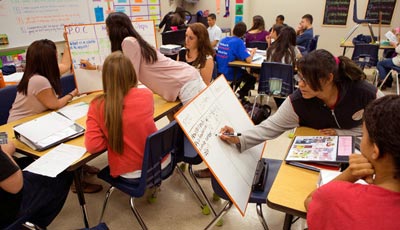
Advanced Placement students at Freedom High School in Orlando, Fla., are offered extra review sessions by a nonprofit group. Aldrin Capulong for The New York Times
ORLANDO, Fla. — Every year, more than 600,000 academically promising high school students — most of them poor, Latino or black — fail to enroll in Advanced Placement courses, often viewed as head starts for the college-bound.
Some of them do not know about these courses, which offer an accelerated curriculum and can lead to college credit. Others assume they will be too difficult. But many are held back by entrenched perceptions among administrators and teachers, whose referrals are often required for enrollment, about who belongs in what has long served as an elite preserve within public schools.
“Many teachers don’t truly believe that these programs are for all kids or that students of color or low-income kids can succeed in these classes,” said Christina Theokas, director of research at the Education Trust, a nonprofit group. Ms. Theokas said that if those underrepresented students had taken A.P. courses at the same rate as their white and more affluent peers in 2010, there would have been about 614,500 more students in those classes.
In an effort to overcome those obstacles, an increasing number of school districts, including Boston, Cincinnati and Washington, have recently begun initiatives to expand Advanced Placement course offerings and enroll more black and Hispanic students, children from low-income families and those who aspire to be the first in their generation to go to college. In the spring, lawmakers in Washington State passed legislation encouraging all districts to enroll in advanced courses any student who meets a minimum threshold on state standardized tests or the Preliminary SAT exam.
While some critics say A.P. classes are little more than another round of test prep, supporters say they can foster a culture of learning. Humberto Fuentes, a senior here at Freedom High School taking his first A.P. classes, in English literature and economics, said they were the first time he had been around peers who enjoyed school.
“In regular classes, people are trying to distract you with music videos or saying, ‘Hey, look at this cat playing a piano’ on their phones,” said Humberto, 17, who emigrated with his parents from Ecuador when he was an infant and hopes to be the first in his family to attend college. “Whereas in an A.P. class, they will show you something from the text and say, ‘Hey, this is fun.’ ”
Expanding access to the advanced classes can require far more of teachers. “If A.P. courses are going to be a successful experience for a variety of students,” said Trevor Packer, the head of the Advanced Placement program at the College Board, the nonprofit organization that administers the exams, “A.P. teaching can’t rely on the ‘sage on the stage’ model that characterized and continues to characterize some of A.P. teaching today.”
At Freedom High School, teachers offer tutoring at lunchtime, after school and on Saturdays. Starting this year, their district, Orange County Public Schools, allocated $12,000 to $14,000 to each high school to pay for extra instructional time for A.P. students. Many students are also enrolled in study review classes sponsored by Advancement Via Individual Determination , a nonprofit group that works to help prepare disadvantaged students for college.
Cashira Chery, a lanky 14-year-old whose mother works as a hotel housekeeper, is one of the new A.P. students. In middle school, she was a straight-A student who scored well on standardized tests, and her guidance counselor at Freedom High registered her for two Advanced Placement courses, biology and geography.
Sometimes, Cashira said, she asks classmates to “dumb down” material. But she is determined to stick with the courses, which she sees as prerequisites to her plans to pursue a career as a pediatrician or an engineer.
“It’s very important to finish college,” said Cashira, who is the daughter of Haitian immigrants. “Not finishing college has gotten my mom into her job.”
As A.P. classes across the country have opened to a more diverse group of students, some teachers and parents worry that instructors will be forced to water down the curriculum, while some educational experts say there is little conclusive evidence that students who take such courses perform better in college.
In Orlando, however, school officials are convinced that the courses will improve their students’ chances in college. Three years ago, the district dropped its requirement of teacher recommendations for A.P. classes, and schools began mining data from Preliminary SAT exams more intensively to find students with the aptitude for more difficult courses.
“We wanted to find the students who might be flying under the radar,” said Barbara Jenkins, superintendent of Orange County Public Schools, the country’s 10th-largest school district, where about half the black and Latino students with qualifying test scores take A.P. classes.
At Freedom High, a campus of 3,240 students, the administration began a push to increase A.P. enrollment five years ago, taking advantage of state bonuses for teachers whose students pass A.P. courses. Since 2009, the number of students taking the advanced courses at Freedom has nearly tripled, with the school offering 150 sections in 30 subjects, including macroeconomics, computer science and Mandarin.
Read the full article by Motoko Rich, New York Times.