By Mary Wiens, CBC News
Almost four decades ago, the first Vietnamese refugees began arriving in Toronto, traumatized and penniless, following the Communist takeover of South Vietnam.
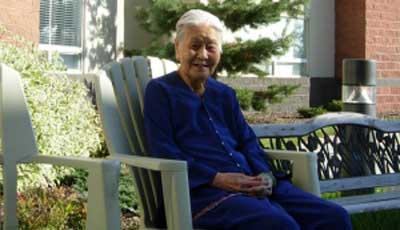
A self-described happy grandmother who is part of the Golden Age Village for the Elderly project. (Golden Age Village for the Elderly)
Today, many of those refugees are aging, including about 100 living in nursing homes scattered across the GTA.
As a community volunteer, Thanhnha Nguyen often visits elderly Vietnamese in those homes. She will never forget one elderly woman — the only Vietnamese resident in one of the largest nursing homes in the GTA.
Like many elderly Vietnamese, the tiny woman spoke no English. Unable to eat the pasta and meat-based meals that the home provided, she weighed only about 90 pounds. “She was just bones and skin,” recalls Thanhnha.
Many Vietnamese seniors feel like outsiders in these retirement homes, says Thanhnha, but for this particular woman the sense of isolation was so devastating that she had tried to end her life.
Thanhnha recalls asking the elderly woman why her face was so pale and blue. “She told me she had tried to bang her head against the wall to try to kill herself,” says Thanhnha.
For Thanhnha, it was a turning point. “That’s when I said, we have to do something for our community — for our parents.”
Thanhnha, a long-time employee of RBC Financial Services, vowed that she would help raise funds for a retirement home for Vietnamese seniors — staffed by people who spoke their language and where Vietnamese seniors would be served traditional rice-based meals.
Today, after more than a year, her dream of building the Golden Age Village for the Elderly is partially realized.
A volunteer board of seven fundraisers led by the Buddhist monk Venerable Thich Thien Tam, who successfully led a fundraising campaign to build a Vietnamese seniors home in Edmonton, the group has already purchased a six-acre property in Vaughan near Canada’s Wonderland.
About 100,000 Vietnamese people live across the GTA, most of them in Toronto and Mississauga and Vaughan. A 6,000-square-foot home on the property is already being used as a club by Vietnamese seniors.
On most Sundays, up to 100 people show up for tai chi and cooking classes, sharing a communal meal before returning to their own homes. Many seniors are impatient for the day when they don’t have to leave — 600 people are on the waiting list for the as-yet unbuilt retirement home.
For Thanhnha, the work of fundraising takes up every spare moment of her day, forcing her to miss many of her own weekly gatherings with her large extended family. Unlike many Vietnamese families in Toronto, she and her eight siblings are able to look after their own aging parents in their homes.
Her own father, now in his late 80s, helped instill in Thanhnha a lifelong commitment to community activity. Phu Trong Nguyen was a diplomat in the South Vietnam government which was overthrown in 1975 when the Vietnam War ended.
Because of his position, the Communist government suspected him of having CIA connections. Like thousands of former government employees and military officers, he too was sent to a so-called re-education camp for indoctrination.
Thousands of people died of disease and starvation in the prison camps — a tool not just to indoctrinate Vietnam’s educated class, but also a form of revenge, in which many people were tortured.
Read the full article by Mary Wiens from CBC News.