By Peggy Wright, Daily Record
MORRISTOWN, N.J. — Behind the novel legal issues surrounding the lawsuit filed by a teenage private school student against her parents for child support and college costs is a judge’s push for the parties to reconcile, maybe through family therapy.
High school student 18-year-old Rachel Canning, takes the oath in Morris County N.J. Superior Court in Morristown, N.J. March 4, 2014. Her parents, Elizabeth and Sean stand at the right. (Photo: Bob Karp, Morristown, N.J., Daily Record)
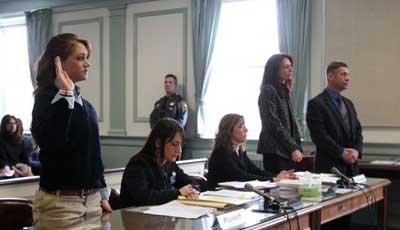
If a full-blown hearing occurs on April 22 in the Superior Court family division of Morris County, both senior Rachel Canning, 18, and her parents, Elizabeth and Sean Canning of Lincoln Park, N.J., would face public exposure of acrimonious allegations they have made against each other in court papers.
“I think everyone has to try to take a step back and realize that this family and Rachel in particular is well worth the effort to salvage, or attempt to,” Superior Court Judge Peter Bogaard said at a preliminary hearing Tuesday.
“Unfortunately, and I’m not going to attempt to cast blame at anyone, but with respect to this it does appear that more energy has been utilized up to this point to devise ways to forever tear apart this family than try to figure out how this family can somehow be brought back together,” Bogaard said.
Bogaard said no to Rachel Canning’s initial requests but scheduled another hearing April 22 to decide whether the Morris Catholic High School cheerleader and lacrosse player was constructively abandoned by her parents and left or whether she chose to become independent.
Unless a settlement is reached, the judge will have to deal with whether Rachel at 18 emancipated herself by taking herself outside her family’s “sphere of influence,” or whether her parents have an obligation to continue supporting her and pay her anticipated college tuition costs by constructively abandoning her and driving her to leave home.
At Tuesday’s hearing, Bogaard asked attorneys for both sides to file legal briefs with him on the doctrines of “constructive abandonment” and “constructive emancipation.”
“It’s a very unique case and Rachel does fall into a limbo zone,” said Herbert Korn, who has handled numerous matrimonial and family cases during 40 years as an attorney.
The Canning case poses relatively uncharted legal territory because a judge cannot force counseling or other forms of resolution on Rachel since she has turned 18 and the majority of New Jersey court cases dealing with parental obligations to pay for college involve parents who are divorced, not together as Elizabeth and Sean Canning are.
“There’s no case law that I’m aware of exactly on point to this. There are fewer options for a judge to look to in a case like this and it’s something the judge will have to wrestle with,” said family law attorney Vincent Celli of Morristown. “On the one hand you have a child, who has the emotional appeal but the parents have the right to act as parents as long as their children are living in their home.”
Read the full story by Peggy Wright from Daily Record.