By Alicia P.Q. Wittmeyer, Foreign Policy
Ever since China planted an oil rig in a disputed area of the South China Sea in early May, the leaders of Vietnam have been searching for leverage against their giant northern neighbor, which shows no signs of retreating. One sign that they may be getting fed up? Over the weekend, they loosed their populace upon the country’s streets to stage anti-China protests.
Anti-China protesters march while shouting slogans during a rally in downtown Ho Chi Minh city on May 11, 2014. Protesters staged one of Vietnam’s largest ever anti-China demonstrations decrying Beijing’s deployment of a deep-water drilling rig in contested waters as territorial tensions soar. (Photo LE QUANG NHAT/AFP/Getty Images)
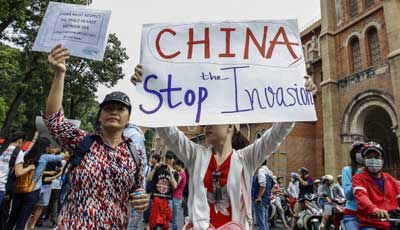
At first blush, the protests may appear an organic outburst of nationalist sentiment, but in Vietnam — a communist country run by an authoritarian government that harbors little tolerance for freedom of speech or of the press — a large-scale street protest remains a big deal. On Sunday, May 10, as many as 1,000 people gathered in Ho Chi Minh City to stage noisy rallies raging against China for hijacking what they see as their country’s natural resources. Another 3,000 assembled in the central city of Da Nang to broadcast a similar message.
The protests continued into the week. On Tuesday, several thousand people in Hanoi, the capital, protested at Chinese-owned factories, even vandalizing some facilities that had refused to stop work.
That these demonstrations occurred at all is a measure of the government’s approval — and perhaps even encouragement. Similar anti-China protests in July and December of 2012, for example, were quickly broken up by the government, and at least 20 participants in the December protests were detained. Today, by contrast, not only is the government allowing the protests to take place, but state-run media is also covering them.
But protesters aren’t playing along entirely. According to Bloomberg, protesters at an anti-China march in Hanoi on Sunday ever so briefly unfurled a banner that read “Freedom for Those Who Love Their Country” — a reference to bloggers recently arrested.
Call it the tricky art of managing an authoritarian protest. While putting on a sufficient show of anger to demonstrate to another country the sort of pressures building at home, the government must also ensure that such protests don’t spiral out of control. Let a protest go too far, and the government could back itself into a corner and wind up unable to negotiate with a country its citizens have been riled up to hate. Then there’s the threat that protests expand to include issues that the authorities would rather not discuss: pesky, imprisoned bloggers, for example.
Vietnam has grappled with this issue since 2007, when anti-China sentiments over disputed claims in the South China Sea first hit a peak. China faces a similar conundrum and has struggled with when and where to unleash anti-Japanese sentiments associated with the ongoing dispute over the Diaoyu/Senkaku Islands.
Read the full story by Alicia P.Q. Wittmeyer from Foreign Policy.