From Banyan
On Saturday morning, December 14th, America’s secretary of state, John Kerry, will travel to Vietnam. One of his talking points, according to the State Department, will be the “empowering role of education”. But it seems like Vietnam has already taken the message.
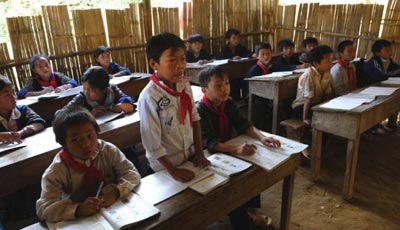
Studnets in a classroom in Vietnam. Photo from AFP
On December 3rd, the OECD released the results from its Programme for International Student Assessment (PISA), an exam administered every three years to 15- and 16-year-olds in dozens of countries. Vietnam recently joined the test for the first time, and it scored remarkably well —higher in maths than America and Britain, though not as high as Shanghai or Singapore. Nguyen Vinh Hien, a deputy minister for education, characterised Vietnam’s overall 17th-place ranking out of 65 countries and economies as a pleasant “surprise.”
The PISA scores, as they are known, measured how a half-million students from randomly selected schools answered written and multiple-choice questions in a two-hour test. Mathematics was the primary focus, but students were also evaluated on reading, science and problem-solving. Coverage of the scores by the Western news media suggested that the impressive maths performance by Vietnam, where per-capita GDP is only about $1,600 , was perhaps a bit humbling for education officials in Washington, London and other self-regarding world capitals.
What explains Vietnam’s good score? Christian Bodewig of the World Bank says it reflects, among other positive things, years of investment in education by the government and a “high degree of professionalism and discipline in classrooms across the country”. But Mr Bodewig adds that the score may be impressive in part because so many poor and disadvantaged Vietnamese students drop out of school. The World Bank reports that in 2010 the gross enrolment rate at upper-secondary schools in Vietnam was just 65%, compared with 89% and 98% in America and Britain, respectively. South Korea’s rate was 95%.
A chorus of Vietnamese education specialists say that Vietnam’s PISA score does not fully reflect the reality of its education system, which is hamstrung by a national curriculum that encourages rote memorisation over critical thinking and creative problem-solving. “Every child in this country learns the same thing,” and nationwide tests merely reinforce the intellectual homogeneity that results, in the lament of To Kim Lien, the director of the Centre for Education and Development, a Vietnamese non-profit in Hanoi. Ms Lien reckons that instead of catalysing educational reform, the score might provide a convenient excuse for complacency in matters of policy. And the old-fashioned, inward-looking Ministry of Education and Training, she adds, is a past master at complacency.
Read the full article from Banyan.