By Jacqueline Le, New Zealand Herald
What’s the price of freedom?
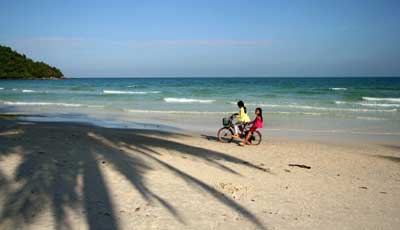
Girls on a bicycle at Sao Beach, Phu Quoc. Sao Beach, still undeveloped except for a couple of seafood joints, is a popular spot for Vietnamese beachgoers to while away Sunday afternoons in hammocks after a big seafood lunch.. (Photo by John S Lander/LightRocket via Getty Images)
In Phu Quoc it’s roughly $8.
That’s how much it costs to rent the scooter we use to make our way through dense, tropical forest to the white sand beaches on this small Vietnamese island.
As we park our yellow Honda at the edge where soil becomes sand and start thinking about a lock, it hits us.
There’s no need to ward against possible theft. No one else is here. It’s just us and the clear blue water.
A secluded paradise is the best way to describe this teardrop-shaped isle in the Gulf of Thailand.
Phu Quoc needs to be seen to be believed, but you better do it quickly because it’s on the cusp of change.
This 48km long island off the coast of Vietnam is actually closer to Cambodia, but was given to the Vietnamese by the French in 1949 when colonial Indochina annexed the Mekong Delta.
I’m told Phu Quoc (pronounced “foo qwock”) is what Phuket was like 40 years ago, before the Thai province became a major tourist attraction full of bars, hotels and stumbling backpackers. For the moment there’s not a single fast food store or major hotel chain here, but it won’t stay this way for long.
This idyllic island is part of the Vietnam Government’s plan to turn the country into the most popular tourist destination in Asia. It’s still a year or two away from achieving this, but already some of Phu Quoc’s unpaved tracks have been transformed into bitumen roads, and sections of the forest have been cleared to make way for large resort complexes.
There’s even a shiny new international airport primed for an influx of package tours.
To add to this, the Government in September approved a proposal for a casino which will reportedly house 2000 slot machines once built. But most of the people who come here on holiday don’t want the sleepy backwater to evolve into a busy tourist trap.
It’s hard to imagine Phu Quoc’s innocent fishing villages and dusty red tracks will one day be overrun by tourists. Roughly 70 per cent of the island is a protected natural reserve, leaving only 30 per cent for human activity.
Read the full article by Jacqueline Le from New Zealand Herald.