By Shih Hsiu-chuan, Taipei Times
Vietnam must take “all measures required” to ensure the personal safety of Taiwanese in Vietnam, as well as the safety of their property, and offer appropriate compensation for losses caused to Taiwanese firms during recent protests, government officials said yesterday.
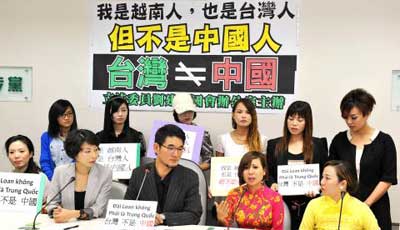
Democratic Progressive Party legislators Chen Ting-fei, front row left, and Liu Chien-kuo, front row second left, hold a press conference in the legislature yesterday. They invited a number of Vietnamese women married to Taiwanese men to discuss how they are Vietnamese and Taiwanese, but not Chinese, which is also the text on the poster in the background and the signs in their hands.May 17, 2014 Photo: Liu Hsin-de, Taipei Times
Following an intergovernmental meeting called by Vice Premier Mao Chi-kuo (毛治國) early yesterday morning, the Executive Yuan issued a statement saying that Vietnam should continue to deploy “adequate military and police officers” to protect Taiwanese and their businesses until the government is able to restore order in restive areas.
Mao demanded that Minister of Foreign Affairs David Lin (林永樂) again call in Vietnamese Representative to Taiwan Bui Trong Van, director of the Vietnam Economic and Cultural Office in Taipei, to lodge the government’s concerns over the recent anti-China protests in Vietnam that have damaged factories and facilities owned by Taiwanese investors.
Lin talked to Bui for almost three hours in the morning, with Bui agreeing to appear at a press conference in the afternoon to address the issues in person.
In addition to expressing severe condemnation of the violent acts during his meeting with Bui, Lin said that he has made three demands of Vietnam — Vietnam apologizes to Taiwan; harshly punishes perpetrators at the earliest possible opportunity; and satisfies all claims for damages that its citizens have caused to Taiwanese firms.
Vietnam should look into the extent of damage caused to the Taiwanese facilities and establish a cooperative mechanism through which both governments can negotiate the issue, based on the investment protection agreement both sides signed in 1993, Lin said.
Read the full story by Shih Hsiu-chuan from Taipei Times.