By Lien Hoang, Voice of America
SAIGON — Vietnam is getting a little tired of coffee and rice. Or at least, it wants to be known for more than being a top exporter of those commodities. So it’s eyeing a more lustrous industry: high-tech and especially electronics.
A scientist presents a silicon wafer. (Voice of America)
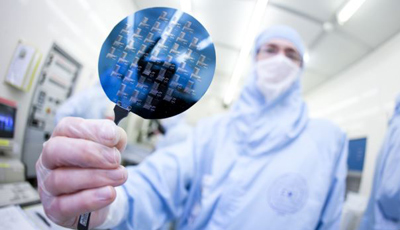
Talks of igniting Vietnam’s own Silicon Valley might be a bit much. But in recent years the country has succeeded in drawing big names like Microsoft, Samsung, and Intel. All three are making Vietnam a major link in their global manufacturing networks. That’s a sign that Vietnam has some desirable traits to help it develop a tech sector. But the question is whether it can turn that potential into an engine for economic growth.
2020 vision
The domestic push into a tech economy is benefiting young engineers like Nguyen Trong Nhan. He returned from Australia with a master’s in programming and quickly found a job at National Instruments last year. The Vietnamese company provides hardware and software to other businesses, but mostly to schools with science labs.
“I think we’re very good in education,” Nhan said. “But now we want to build relationships in industry.”
Most likely, there will be a larger tech industry for his company to serve in the coming years. In 2012, Prime Minister Nguyen Tan Dung signed a decision that laid out a national strategy for science and technology. It projected that by 2020, the value of high-tech products and applications should make up 45 percent of Vietnam’s gross domestic product.
Radhika Srinivasan, IBM’s program director for technology alliances and licensing, said Wednesday at the Vietnam Semiconductor Strategy Summit in Saigon that Vietnam was betting its future on the right field.
“Why should Vietnam – or any emerging economy really – focus on microelectronics or semiconductors?” Srinivasan asked. “It drives innovation and entrepreneurship, and hence fuels economic growth.”
Favorable factors
Investors say they’re drawn to this nation of 90 million people because of its location near China and key shipping lanes, its emphasis on consensus and teamwork, and its entrepreneurial work ethic. Many Vietnamese citizens run family businesses and have a welcoming attitude to foreigners. Some even say it helps that the Vietnamese language, unlike Chinese, uses Roman lettering, which makes it easier for locals to adopt English, the lingua franca of global commerce. Vietnam also has favorable demographics, particularly a young, tech-savvy population that obsesses over tablets and smartphones.
“Favor factors for Vietnam are low wages and a high number of fresh graduates from university,” said Pham Ba Tuan, senior expert at CNS, a large state-run corporation that is working to build a silicon wafer fabrication facility.
Read the full story HERE.