By Vi-An Nguyen, Parade
It’s not the holiday season without A Charlie Brown Christmas, so it’s no surprise that when Jean Schulz, Peanuts creator Charles Schulz‘s widow, decided to do an live online chat , she was flooded with questions—about the holiday special, the classic comic strip, and what her late husband was really like.
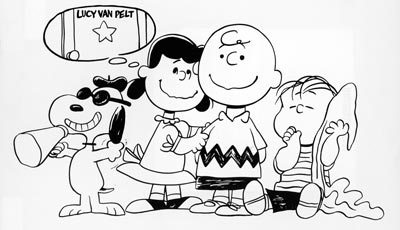
The ‘Peanuts’ gang. (Getty Images)
Was “Sparky,” as the comic artist was nicknamed, really as cranky as he’s rumored to be? What was he like as a husband? And if the Peanuts gang ever grew up, what would they be doing now? Jean, who was married to Charles from 1973 until his death in 2000 and is president of the Charles M. Schulz Museum in Santa Rosa, California, replied thoughtfully to all these queries and more during her “Ask Me Anything” session Wednesday on Reddit, a social news site.
See highlights from the Q&A below:
If the characters had been allowed to age and grow up, what do you think they would be doing for a living?
Jean Schulz: “Oh boy! That’s a good question … you sort of think Linus is probably teaching at some level. Lucy is probably running a software company (I’m making this all up, I have no idea) and Schroeder might be a conductor … And Charlie Brown? He’s such a soft, easy, guy that he’d be doing something like being an oceanographer or studying marine mammals or something? He has so much compassion. He might run the Humane Society. That would be perfect because one of the people Sparky truly loved was the person who ran the Humane Society in Santa Rosa.”
I have read that “Peanuts” was a title unilaterally selected by an editor for the comic strip and your husband did not care for it. Any truth to that and, if so, what was his title of choice?
“Well that is true. Absolutely true. He would have liked it to be called ‘L’il Folks’ … but they didn’t want to use that because there was a previous comic artist, Tack Knight, was still living and he hadn’t drawn the strip in a long time but he still owned the name ‘Little Folks.’ … Also there was a time when you used the word ‘Peanuts’ to describe little kids. So a syndicate editor came up with that … Sparky suggested ‘Good Old Charlie Brown’ and they said no.”
How do you feel that much of your husband’s work are classics?
“I think it’s amazing that all of those things have become part of our culture. He did not set out to write the great American novel, or to do a comic strip that will last 100 years … I think when people asked him, “did you ever think your characters would become part of the culture” it puzzled him a bit and he didn’t have a very good answer for it … I think his answer was something like, ‘I just tried to put everything I had into the comic strip and do the best I could every day.’”
Was your husband a (deeply) religious man? What inspiration did he get from living in that way?
“I think that he was a deeply thoughtful and spiritual man. Sparky was not the sort of person who would say ‘oh that’s God’s will’ or ‘God will take care of it.’ I think to him that was an easy statement, and he thought that God was much more complicated … When he taught Sunday school, he would never tell people what to believe. God was very important to him, but in a very deep way, in a very mysterious way.”
What other comic strips did you or your husband enjoy? [Were you] Calvin & Hobbes fans?
“Oh absolutely! … Of course Sparky liked older comics. He loved Popeye and Li’l Abner … All cartoonists love Little Nemo, but the comic strips that he liked—Cathy (not so much for the drawing but for her situations), The Far Side (he thought it was so funny), [and] he liked a lot of the New Yorker cartoonists too.”
Do you think the Peanuts themes from the past are relevant today?
“Oh absolutely! I still think people struggle with self-worth issues, my goodness yes. Even more now because everybody is picking at you, it seems … I don’t know if he ever said, ‘I’m going to make a group of characters and themes that will last for 100 years,’ but because they came so much from his heart and his unique Midwest background in the Depression when things were tough and everybody worked hard and people came together—those themes are still valid.”
Read the full article by Vi-An Nguyen from Parade.