By JAMI FARKAS, NGUOI VIET
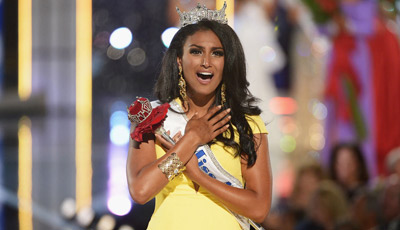
Sunday night, Miss New York, Nina Davuluri, was crowned Miss America 2014. Photo from Getty Images.
When it comes to selecting a Miss America, poise and grace – not color or ethnicity – should be the only measuring sticks.
Thirty years ago today, my friend and I popped a batch of popcorn and sat at the television to watch the Miss America pageant – a ritual for all teenage girls and college students in the early 1980s. I can’t tell you who was crowned Miss America the year before or the year after, but that night – Sept. 17, 1983 – I remember as clearly as anything.
That’s the night Vanessa Williams, Miss New York, looked confident and stunning as she walked the stage in her white evening gown, and later, modest one-piece white swimsuit. Her dress sparkled as her beautiful voice belted the standard “Happy Days Are Here Again,” made famous as the 1932 campaign theme for FDR but also a part of countless films through the years. On that night in Atlantic City, N.J., when host Gary Collins called her name, Williams had made history.
Williams, a student at Syracuse University, had become the first Miss America of African American descent. Her runner-up, Suzette Charles, Miss New Jersey, also was an African American.
My stepfather walked away from the television in disgust. He couldn’t believe what he had just seen: a black Miss America.
Without Facebook or Twitter, without text messaging, blogs or many news talk radio shows, I didn’t get the feel that anyone outside of my house felt something was amiss with a black Miss America. To me, she was charming, well-spoken, lovely, talented and smart – everything Miss America should represent.
I hadn’t thought about that night in 30 years until Monday morning, when I awoke to see Twitter and Facebook erupt with the news of the latest young lady crowned Miss America in Atlantic City. With the pageant no longer appointment television for me, I had no idea that another Miss New York from the Syracuse area, Nina Davuluri, had made Miss America history. The first Indian American to win the title, Davuluri was one of three women of Asian descent to finish in the pageant’s top five.
Throughout the day yesterday, I saw clips of that latest young woman on stage to represent her state, and ultimately her country. Davuluri danced a Bollywood number and shone as brightly as her yellow dress when host Chris Harrison announced her as the winner.
While Williams’ handlers likely could have shielded her from racist comments, Davuluri became a target on social media for Americans to vent about her selection. Unhappy Davuluri didn’t represent the tall, blonde beauty queen stereotype, thousands of Americans took to social media to condemn her.
On Twitter, someone called her “Miss 7-11,” a reference to the number of Indian Americans who own convenience stories. She was likened to a terrorist.
One of the hallmarks of a Miss America is the ability to exhibit grace under pressure. That’s what Davuluri did in her first news conferences after her selection.
“I’m so happy this organization has embraced diversity,” she said. “I’m thankful there are children watching at home who can finally relate to a new Miss America.”
Davuluri said that she could get over the hurtful comments posted to social media sites. “I have to rise above that. I always viewed myself as first and foremost American.”
I didn’t witness Dr. Martin Luther King Jr.’s “I Have a Dream” speech, which he delivered 50 years ago, that extolled all Americans to work together as one and treat each other as one. But his words still resonate. In part: “I have a dream. It is a dream deeply rooted in the American dream. I have dream that one day, this nation will rise up, live out the true meaning of its creed: ‘We hold these truths to be self-evident, that all men are created equal.’”
Shouldn’t the same be said for Miss America winners?