By Roberto A. Ferdman, Quartz
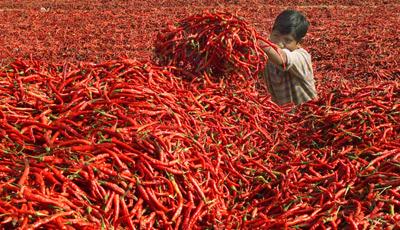
No matter how many chili peppers Huy Fong harvests, it may never be enough. Reuters/Amit Dave
If David Tran were a more conventional CEO, he would be a fixture at conferences, a darling of magazine profiles, and a subject of case studies in the Harvard Business Review. Sriracha hot sauce, made by Huy Fong Foods, which Tran founded 33 years ago in Los Angeles, is one of the coolest brands in town. There are entire cookbooks written to celebrate Sriracha’s versatility; memorabilia ranging from iPhone covers to t-shirts and all sorts of other swag ; a documentary in the works to chronicle its rise; and innumerable imitators. Sriracha sales last year reached some 20 million bottles to the tune of $60 million dollars, percentage sales growth is in the double digits each year, and it does all this without spending a cent on advertising.
Yet Tran shuns publicity, professes not to care about profits, hardly knows where his sauces are sold, and probably leaves millions of dollars on the table every year. His dream, Tran tells Quartz, “was never to become a billionaire.” It is “to make enough fresh chili sauce so that everyone who wants Huy Fong can have it. Nothing more.”
Product before profit
Today hot sauce is an emerging global business. The industry, which is among the 10 fastest growing in the US, now rakes in over $1 billion a year in global sales. But when Tran arrived in Los Angeles back in 1980, he was both jobless and hot-sauce-less. Having recently arrived from Vietnam, Tran found it near impossible to find a spicy additive worthy of his palate. The Southeast Asian community in Los Angeles, he soon realized, was suffering from the same hot sauce withdrawal.
In a matter of months, he had arrived at his rendition of Sriracha, a version of the Thai sauce made with hybrid jalapeño peppers (red or sometimes orange in color), vinegar, sugar, salt, and garlic, and was delivering it to local markets throughout the city. Soon thereafter, he was packaging it into its now unmistakable clear bottles with the rooster logo and green caps.
But the only hope he ever harbored was to provide Vietnamese immigrants with a hot sauce worthy of their pho soup. Growing a bona fide business wasn’t an afterthought—it wasn’t a thought at all. “I started the business with my eyes closed. There were no expectations at all,” he said.
He still runs it in much the same way: with his eyes closed. He says he has not once hiked the wholesale price at which he sells Sriracha—a number he won’t share with anyone—no matter that inflation has more than tripled food prices since 1980. He can’t tell you where Sriracha is being sold, because all he knows is that Huy Fong has ten distributors, to whom he has handed off his hot sauce for over 10 years now. “We don’t have a detailed record on where it’s being sold,” Tran admits. Griffin Hammond, who is making the documentary about Sriracha, tells Quartz that as far as he knows, Sriracha is available in the US, Canada and Europe. “But it’s probably sold elsewhere, too,” he conceded. “At the very least, I know that on the bottle there is English, Chinese, Vietnamese, French and Spanish.”
Tran also learned only recently that Sriracha has become a popular ingredient among sushi chefs, who have been using it to spice up spicy tuna rolls for years. “I didn’t know until one of my distributors told me,” Tran said. In fact, says Hammond, it’s “almost always the spicy ingredient in spicy tuna rolls these days. It probably makes up a pretty significant portion of their sales.”
Sushi chefs aren’t the only ones. Restaurant chain P.F. Chang, which has 204 branches in the US and worldwide, offers Sriracha-flavored dishes. Chef David Chang (no relation to P.F. Chang’s) has bottles of Sriracha on every countertop of his Momofuku Noodle Bar restaurant in New York. Bon Appétit magazine declared the sauce the ingredient of the year back in 2010, and Cook’s Illustrated called it the best-tasting hot sauce in 2012. Though it didn’t win, Sriracha was one of three new flavors chosen in Lays potato chips’ new flavor contest last year.
Read the full article by Roberto A. Ferdman from Quartz.