By Ali Weinberg, ABC NEWS
Flare-ups between China and Vietnam in the South China Sea, in which both sides have fired water cannons and sparked protests back on shore, are a test for the Obama administration’s Asia policy, as it balances the desire for good relations with China with the need to support smaller countries in the region, experts said.
A Chinese ship, left, shoots water cannon at a Vietnamese vessel, right, while a Chinese Coast Guard ship, center, sails alongside in the South China Sea, off Vietnam’s coast, May 7, 2014. Vietnam Coast Guard/AP Photo
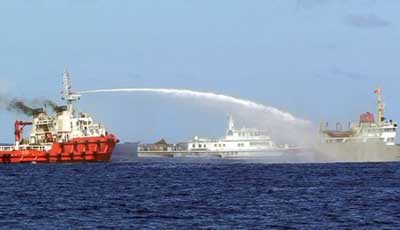
Since China stirred tensions on May 1 by putting an oil rig into waters not far from the disputed Paracel Islands, which both China and Vietnam claim, the United States has issued several statements calling for calm on both sides.
Secretary of State John Kerry called his Chinese counterpart Wang Yi on Monday, condemning China’s “provocative” decision to introduce the rig and other government vessels into the disputed territory.
But the United States faces a conundrum even by weighing in on the situation, several Asia experts said, noting that the administration wants to build stronger ties in the region, but doesn’t want to risk antagonizing China.
Abe Denmark, vice president at the National Bureau of Asian Research, said that if tensions persist, other countries in the area like the Philippines and South Korea, which have their own territorial issues with China, might look to the United States to intervene.
“They’re worried about maintaining their own territorial integrity and their own sovereignty and they see the United States as the only country that can balance a rising China,” he said.
In fact, when he visited the Philippines at the end of April, President Obama signed a new defense agreement with the Manila government that increases opportunities for the U.S. to train Philippine forces and boosts its Coast Guard and police force.
China views the United States’ so-called “rebalance” to Asia as a potential threat, believing its focus in the region is encouraging China’s smaller neighbors to stand up to it, Denmark said.
One of China’s top generals, Fang Fenghui, accused the United States of doing just that when he visited the Pentagon Thursday, saying the United States “stirred up some of the problems which actually [made] the South China Sea and East China Sea not so calm as before.”
Regardless of their size, all countries in the region view the “rebalance” against the backdrop of their own interests, Michael Auslin, an Asia expert at the American Enterprise Institute, said.
Read the full article by Ali Weinberg from ABC NEWS.