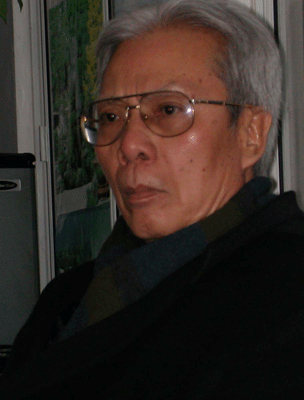
Photo courtesy of www.yale.edu
By THAI A. NGUYEN-KHOA
Early Tuesday, Nguyen Chi Thien, a dissident poet from Viet Nam, passed away quietly at 73 in a Santa Ana, Calif., hospital after refusing life support.
He was one of Viet Nam’s longest prisoners of conscience, spending a 27 years in various prison camps in North Viet Nam.
Born in Ha Noi in 1939, in a family of six, his elder brother Nguyen Cong Gian joined Viet Nam’s National Army and was the only one in his family to move South; he later rose to the rank of lieutenant-colonel in the ARVN. After 1975, he, too, became a prisoner in Ha Noi’s reeducation camp for 13 years.
In 1960, while substituting for a teacher-friend, he told the class that it was the United States that defeated Japan in 1945 after dropping two atomic bombs on Hiroshima and Nagasaki and not – as the textbook affirmed – the Soviet Union that ended WWII by defeating Japan’s Imperial Army in Manchuria. This landed him in prison for more than three years.
In prison, he began composing his poems in his head and committed them to memory, sometimes by reciting them to his jailmates. In 1966, he was jailed again, this time for more than 11 years after his “reactionary” poems were circulated in Ha Noi and Hai Phong. Released in 1977, two years after the fall of Sai Gon, he lived under constant police surveillance.
In 1979, fearing that he might not survive if imprisoned for the third time, he was determined to smuggle his poetry out of Viet Nam. Thien made a bold attempt by entering the British Embassy in Ha Noi, where he requested British diplomats to ferry out his poetry collection of 400 poems to the free world. For this, he spent the next and last 12 years in prison, mostly at the infamous Ha Noi Hilton, where Sen. John McCain was once held.
His poetry first appeared in the U.S. in the early 1980s under the title “A Cry from the Abyss” then published as “Flowers from Hell” when it was translated into English, French, German, Dutch, Spanish, Chinese, Czech and Korean. Thanks to this international following, Thien won the Rotterdam’s International Poetry Prize in 1985. In 1988, he also won the “Freedom to Write” award.
After the collapse of the Soviet Union, he was finally released in 1991 and resettled in the U.S. in 1995, the same year he was honored by Human Rights Watch.
Like many Vietnamese, I got to know the poet personally, having taken up his cause as a student at the University of California in the early 1980s. We organized many poetry recitals on campus and at other colleges and universities around the Bay Area to raise consciouness about the prison poet and Viet Nam’s repressive state of morose socialism.
I feel a great sorrow not only at his passing, but at the loneliness and despair that he and many exiled Vietnamese dissidents must have felt. They have not been allowed to visit Viet Nam and have watched the country make a great leap backwards