By Van Tran, Esq.
No one goes through life without experiencing what social scientists and psychologists grandly describe as “life-defining” events – historical and personal incidents deeply embedded in one’s consciousness that influence one’s destiny, character and future conduct. For most overseas Vietnamese who are old enough to remember, one of those life-defining events was the day the Vietnamese communists took over South Vietnam — April 30, 1975 — and the day we left our homeland in search of freedom.
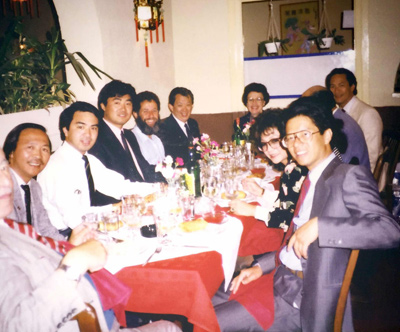
Van Tran, Esq. (second from left) and musician Nam Loc (left) at dinner at Dai La Thien restaurant, Jerusalem, with representatives from World Zionist Organization, Asian group. (Photo: Ms. Maeley Tom)
April 25, 1975, was that life-defining date for me as my family hastily left Saigon on a pre-dawn flight in a U.S. Air Force C-130 out of Tan Son Nhut International Airport. As a 10 year-old boy, that was the last time I saw my beloved homeland. It will be 40 years this month, but the memory of that fateful day is still deeply etched in my consciousness as if it occurred just last week.
Fast forward to late April 1988, exactly13 years after the Fall of Saigon, when I had an opportunity to witness the joy and true meaning of national independence from a people subjugated and driven from their homeland for over 2,000 years. Sometimes known sarcastically as “God’s Chosen People,” the Jewish Diaspora, similar to the Vietnamese overseas emigration, has spread to all seven corners of the world over the centuries. There are even Chinese Jews and Jews in Ethiopia.
It was while with the Jews in Israel that I experienced the collective pride of a formerly oppressed people, who fought for and won independence, while reflecting on the sad fate of the Vietnamese people, my people, who still suffer under a dictatorial and corrupt regime that continues to wage war on its own citizens. All of this in the same week.
In April 1988, the World Zionist Organization (WZO), an internationally based organization that had a hand in creating the modern State of Israel, invited me, along with eight other Asian civic leaders from throughout the United States, to travel on a 10-day trip to Israel. The WZO billed the trip as a “study tour.” Among members of the delegation included a senior adviser to then-California Gov. George Deukmejian, a police commander from the Philadelphia Police Department and a San Francisco County supervisor. In reality, the Israeli government, through a number of its quasi-non governmental affiliates such as the WZO, regularly invited and hosted many political delegations to Israel as an effective way to lobby American public opinion, soft-selling its policy with Arab nations while building closer ties with American leaders through bonding opportunities with similar in-country excursions.
I was not sure why I was even invited to this trip by the WZO. I was a 23-year-old special assistant to then-State Sen. Ed Royce at the time and was, by far, the youngest member of the delegation. Still, I gladly accepted the invitation. There was another Vietnamese on the delegation to Israel whom I never had met before, but one I came to know and became fast friends with – the famous lyricist and entertainment show host Nguyen Nam Loc. *Anh Nam Loc came to the delegation with a real day-time job title of Director of Refugee Services for Catholic Charities in Los Angeles. We were the two Vietnamese in the delegation to visit a nation with a very turbulent history, but through the sacrifice and resilience of its people had found its rightful place in the world community. For me, the Israel trip was full of meaningful surprises and poignant revelations.
We flew to Israel on El Al, the Israeli national airline, and our group landed at Ben Gurion Airport on the outskirts of Tel Aviv on April 26. The Israelis were in the midst of preparing to celebrate their 40thNational Independence Day, from 1948 to 1988, to mark the founding of the State of Israel. It was a year-long national celebration that also recognized the incredible progress and potential of the Jewish people around the world.
The first impression I had of this country, which shares the same hot weather and dry terrain of San Bernardino County, was the Star of David flags – the Israeli national symbol – that lined the freeways and streets on our bus trip from the airport into downtown Jerusalem, about 35 miles away. The Star of David, emblazoned in blue on a white field, was my first indelible impression of Israel. I was deeply impressed that the Jews were so proud of their national flag. And they rightfully displayed it. Everywhere.
During our stay in Jerusalem, the capital of Israel, we visited with many government officials and members of the Knesset (Israeli Parliament). We toured hospitals, museums and schools. By interacting with a diverse group of Israelis, from politicians to academics, the delegation was able to learn much of Israel’s history, national struggles and the ongoing conflict that threatens to wipe Israel from existence by its Arab neighbors.
To our delight, Anh Nam Loc and I also discovered that there were several hundred Vietnamese refugees living in Israel. We learned that the post-1975 Vietnamese exodus had spread to Israel during the height of the Vietnamese “boat people” crisis in the late 1970s, when Prime Minister Menachem Begin at the time accepted nearly 300 Vietnamese from Southeast Asian refugee camps. Despite heavy opposition to the government’s decision from many Israelis, Begin pointedly reminded his fellow countrymen that Israel had a moral duty to help these Vietnamese refugees. He said that it was not too long ago the Jews from Europe and North Africa were also stateless and in need of a safe haven from Nazi persecution. The Israeli decision to take in the Vietnamese was a humanitarian gesture that only one formerly oppressed people can fully appreciate when another group of people goes through the same desperate predicament.
In one of the delegation’s dinners in Jerusalem, we had Chinese cuisine at a local Chinese restaurant that was owned and operated by a Vietnamese refugee named Le Quang Phong, a former South Vietnamese Air Force officer who flew helicopter gunships during the Vietnam War. None of us knew the restaurant, or its owner, prior to the dinner and it was pure coincidence that a Vietnamese national was the operator. Anh Phong was so happy to have met Anh Nam Loc and me, his fellow countrymen who had all the way from America to Jerusalem and dined at his restaurant, the Dai La Thien. Immediately, the three of us shared that special bond of being so far away from our homeland; but as fellow Vietnamese, our common affinity was cemented by a common political identity, culture, heritage and language.
At the time, I found it sadly ironic that the three of us, like millions of other Vietnamese, were scattered in countries thousands of miles from Vietnam, and that we were in Israel preparing to observe two important anniversaries – the 40thIndependence of Israel and the Fall of South Vietnam, both in the same week. I question why history could be so cruel. The collective joy of one nation directly juxtaposed against the pain and loss of another.
I distinctly remembered one spontaneous moment during dinner at the Dai La Thien that brought tears to many delegates at the table, especially to the three of us Vietnamese – Anh Phong, Anh Nam Loc and me. It was when Anh Phong came out of the kitchen to check on the guests, toward the end of the dinner, that Anh Nam Loc and I suggested that we sing a Vietnamese song for our fellow Asian delegates and Jewish friends. I also informed the group that we would like to perform the song as a commemoration of the anniversary of the Fall of South Vietnam, which was the day after next. We, three Vietnamese then proceeded to the middle of the table and began to sing, a cappella, the only song that I barely remembered the lyrics to, “Viet Nam, Viet Nam.”
“Viet Nam Viet Nam nghe tu vao doi
Viet Nam hai cau noi ben vanh moi
Viet Nam nuoc toi…”
It must have been a strange site to behold, but it was a deeply meaningful one to me. After the rendition, I sat down, feeling a pang of emotion and the irony of it all. Here I was in a Chinese restaurant in Jerusalem owned by a fellow Vietnamese expatriate, celebrating the 40thanniversary of the founding of Israel, while at the same time, I was reminded of the tragic anniversary of my homeland and the cruel fate that date had brought upon millions of my fellow Vietnamese. I realized then that no matter where I was and what I did, I am still a Vietnamese at heart.
All of the conflicting emotions I felt in Israel also gave me a sense of hope for my people. I reasoned that if it took the Jews survived more than 2.000 years wandering in the wilderness before they could finally claim Israel as home, then the overseas Vietnamese community could achieve the same goal, hopefully in a much shorter time, of helping Vietnam to become truly free, independent and democratic. I have great admiration for the Jewish people, but I have no less faith in the Vietnamese for our perseverance and resourcefulness.
Anh Phong was so happy to see Anh Nam Loc and me that he wanted to spend as much time as possible with us while we were in Jerusalem, suggesting that he would like to invite a group of local Vietnamese living in the Jerusalem-Tel Aviv region for an “overnight wake.” or dem khong ngu, on the eve of April 30. Anh Nam Loc and I readily agreed to the idea; indeed, we were curious about the life of these newest Vietnamese-Israelis.
About 20 local Vietnamese happily met us at a pre-designated spot on the beach of Tel Aviv, armed with guitars, firewood, kerosene and loads of provisions such as beef, fish, crabs and bread for the makeshift barbeque. Indeed, we were going to commiserate about the loss of our homeland, but we were going to do it on a full stomach!
For me — a young Vietnamese man of 23 sitting on the white sandy beach of Tel Aviv overlooking the Mediterranean while yearning for my homeland along with my fellow Vietnamese over the strumming of sad melodies on the guitars, thinking of a country lost and opportunities missed – this was an unforgettable and sad experience. Our group lingered on the beach until the wee hours before sunrise, sharing our stories and our personal experiences while implicitly reaffirming our identity as Vietnamese. We talked. We sang. We laughed. We cried. Anh Nam Loc performed one of his most well-known songs, “Farewell Saigon – Saigon Oi Vinh Biet,” a poignant ode to all those Vietnamese exiled by war and conflict. Like the Jews of Israel, we earnestly shared our aspirations for a brighter future for our people and nation.
During the Israel trip, I befriended one of the delegation’s Jewish guides, a man by the name of Ben Edelstein, who was born and educated in England. I could never forget this man, an English gentleman who was very knowledgeable about Israel, its history and politics, contemporary and ancient. He spoke English with a courtly British accent and must have been in his late 60s at the time. Ben told me that he had fought in World War II against Nazi Germany. He had volunteered and received training as a Royal Air Force pilot and was about my age at the time he first flew into combat against the German Luftwaffe.
Ben’s service and exploits in the RAF during World War II were very impressive, but not nearly as impressive and meaningful as how he came to resettle in Israel, I learned when I broached him on this subject. Ben told me that as a British citizen, he and his family actually had no dealings with, nor even set foot in Israel – known as Palestine prior to 1948. However, as a Jew, he felt morally obligated to join the cause of national independence in helping to establish a Jewish homeland for his fellow Jews around the world.
During the War of Independence from 1946 to 1948, Ben volunteered with the Haganah, which was the precursor of the Israeli Defense Force (IDF), to fight for the establishment of the modern State of Israel. Given his WW II experience, Ben responded to the call from the fledgling Israeli government to train newly commissioned Air Force officers, as Israel became an independent nation and must be able to fend on its own.
What impressed me most about Ben Edelstein was not necessarily his military skills and experience, which were considerable. Certainly, Ben helped to build the modern IDF. The most memorable lesson I received from this British gentleman was that Ben Edelstein was a proud and honorable Jew. He did not hesitate to sacrifice for his people’s cause — and not even for a country when there was none — to fight for what he believed his people wanted and rightfully deserved. Ben told me that during the war for Israel’s independence, there were many young Jewish men and women, who like himself, came from all over Europe and America to Palestine to contribute to the cause of a Jewish homeland, even though they never set foot in what is now known as Israel.
Ben’s personal story made me think hard about the ongoing Vietnamese cause for freedom and democracy currently being waged overseas and inside Vietnam. In one respect, the Vietnamese have it easier than the Jews in that we already have a country. We do not need to create a new country. We just do not have a legitimate government that represents the true aspirations of the Vietnamese people. The Jews had neither prior to 1948. But, they now have both, in spite of 2,000 years of suffering from countless brutal state-sponsored pogroms and the Nazi-inspired Holocaust.
Israel was the Jewish promised land, and Jews all over the world — no matter how far away from Jerusalem — always intended to keep that promise to build one. Ben shared with me that in the Jewish tradition, especially before the founding of modern Israel, the centuries-old refrain spoken among the Jews is, “See you in Jerusalem, next year!” This familiar declaration means much more than one physically being present in Jerusalem, a land that the Jews considered sacred, but a fervent prayer for all Jews to find peace, equality and justice. It is a statement of their Jewish identity and what they want to be. It is their rallying cry, “See you in Jerusalem, next year!”
As the 40thanniversary of the Fall of South Vietnam approaches, we should view this occasion as a time to renew our commitment to the cause of freedom and democracy in Vietnam. Forty years is a long time to wait, but not nearly as long as the two millenniums the Jews had to endure before they found their promise land. The duty and moral obligation to carry on the fight for a free and democratic Vietnam must be handed from one generation of Vietnamese to another, as our parents and grandparents gradually pass on.
Indeed, we need thousands of Vietnamese who possess the same indomitable spirit of Ben Edelstein. We do have many Vietnamese Ben Edelsteins, inside and outside of Vietnam, and they need our help. Each one of us, as a Vietnamese expatriate, has a responsibility of not forgetting why we are here, and what needs to be done for our fellow Vietnamese still languishing under the yolk of communism. This responsibility also extends to teaching our children and their children of never forgetting who they are, the difficult history of their parents and grandparents, and the obligations they have in carrying on the mission of peace, equality and justice in the land of their ancestors.
Vietnam has little choice but to change for the better. The wheel of history and civilized development will indiscriminately crush any one blocking its way. It is a matter of time. And it is largely up to the communist leadership in Vietnam to galvanize enough collective courage and political will to discard an ideology that was built on tyranny, lies and bloodshed. Time is not on their side. As freedom-loving Vietnamese, let us share the same fervent prayer for all Vietnamese by declaring, “See you in Saigon, next year!”
I know Ben Edelstein would approve.
—————————
* The Vietnamese-language term “Anh” literally translates as “Elder Brother.” The term is a common Vietnamese salutation designated for an older male individual.
Attorney Van Tran, a licensed member of the California State Bar since 1994, is currently practicing corporate law in Newport Beach, Calif. From 2004-10, he was a California State Assemblyman representing Orange County, serving as the first Vietnamese American member of any state legislature in the nation. Prior to his legislative service, he was a councilman and vice-mayor of the City of Garden Grove, Calif.