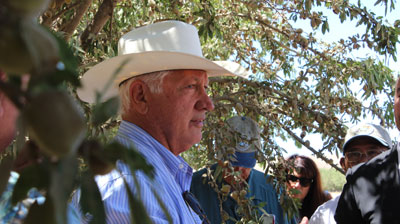
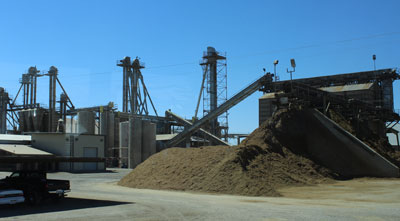
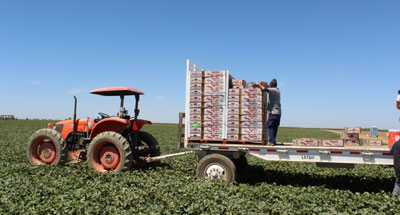
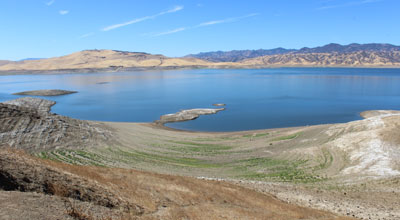
Thuy Phan/Nguoi Viet LOS BANOS, Calif. — “Food grows where water flows.” That is the sentiment that Mike Wade, executive director of California Farm Water Coalition, is trying to drive into the minds of Californians as the drought continues to wreak havoc and the farming community takes the heat for its consumption of water. In the Central Valley, where most of California’s farming takes place, the need for water is crucial for farmers to continue – and grow – their livelihoods. It’s something Wade is passionate about, especially when it comes to educating the public on the role farmers play. In terms of California’s economy, for one, it’s a huge role: agriculture brings in $46 billion a year in revenue with dairy, tomato and almond farms leading the way. The San Luis Reservoir is at 50 percent amid the drought. (Photo: Thuy Phan/Nguoi Viet) “We are in the fourth year of an extended drought, and the San Luis Reservoir is half empty,” Wade said. “We also have water-management issues, which means we haven’t been able to to move the water like we’d like to into the reservoir as often as we can. There’s no better value of water than to use it to grow food to nourish people.” Wade spoke as part of a state water project inspection trip in August that was sponsored by the Metropolitan Water District of Southern California and the Municipal Water District of California. Assemblyman Travis Allen, R-Huntington Beach, hosted close to two dozen people within the community to see various components of the state’s water system and how they were affected by the severe drought. It was also a chance for people to see how farmers are faring in the drought and to clear up misconceptions in the media about where California’s water was going. Wade said he wanted to clear up the misconceptions about the amount of water farmers use to grow their valuable crops. Currently, California farmers grow 82 percent of the world’s almonds and bring in more than $6 billion annually from the crop. “It takes a third of a gallon to grow an almond,” Wade said. “When we produce an almond, we produce a byproduct — the hull and the shell — and those take about two-thirds of the water in production. An almond really only takes a third of a gallon, not the gallon that everyone has been hearing about in the news.” The hull and shell are ground up and used as livestock feed. The California mountains’ snow pack, which provides the main source of water in the Central Valley, is at 5 percent of its historical average. A recent study by researchers at UC Davis projected that the drought would cost California’s economy $2.7 billion in 2015 alone. Farmer Joe Del Bosque, 66, who is known as the “melon king,” also grows almonds, cantaloupe and tomatoes on his 2,000-acre farm. Del Bosque said almonds are being unfairly categorized as the enemy when it is the demand of the people. Joe Del Bosque talks about the almond trees he has and what it takes to grow them. (Photo: Thuy Phan/Nguoi Viet) “It’s really simple: we grow what people want to eat,” Del Bosque said. “Right now it’s almonds. People who go to the grocery store and buy produce are the ones that dictate what farmers grow.” Because of the drought and the need to ration out the water for crops that will yield the most profit, Del Bosque has had to leave “hundreds of acres of land” inactive due to a lack of water to sustain them. “When that happens, it means there are no jobs for people in this farming community that depend on it to feed their families,” Del Bosque said. Assemblyman Travis Allen and his team stand in front of the San Luis Reservoir. (Photo: Thuy Phan/Nguoi Viet) So far, the drought has been so severe it has prompted Gov. Jerry Brown to issue a mandatory 25 percent cutback to water usage across the state earlier this year. However, following Brown’s mandatory cutbacks, the state’s water board announced that Californians continued to conserve water, reducing water use by 27.3 percent. Farmers have had to purchase water at higher prices– $2,000 per acre-foot compared to $140 per acre-foot last year– reducing their profits and creating more need for water management solutions. Allen said he felt one of the solutions to this drought was to build more reservoirs to collect water for future use. “We need more water storage,” Allen said. “We need a greater ability to capture the water in the wet years, so when the dry years like we are having now, we have enough water to go around. We just passed a water bond in the past year and appropriated $2.4 million for this. Currently we’re working up in Sacramento to make sure the governor is spending this money so we can start building the storage and getting a solution to this problem.” Almonds hulls produce a by-product used to feed cattle. (Photo: Thuy Phan/Nguoi Viet) In addition to visiting Del Bosque Farms, the tour included a stop at the International Center for Water Technology at California State University, Fresno. There, researchers found a way to minimize water usage with soil moisture sensor-based controllers. When moisture levels get too low, it triggers irrigation to the plants. By working to improve this technology, researchers have been able to lower the cost of these sensors to make them more available to farmers. The final stop was at the Harris Ranch in Coalinga, a farming community just south of Fresno to show how a dairy and regular farm was managing during the water crisis. The ranch faces the same difficulties as Del Bosque with more than 14,000 acres of farm land and a cattle operation that raises 250,000-plus cows a year. Workers harvest melons on the Del Bosque Farm. (Photo: Thuy Phan/Nguoi Viet) “We fallowed (left barren) 10,000 acres this year,” said William Bordeau, executive vice president of Harris Farms Inc. “The only reason we didn’t fallow all of it is because we have permanent crops we need to keep because they were a huge investment. It takes a large amount of water to farm a large amount of crops so we have to find a solution. Water is the lifeline to jobs in our community.” Bordeau, a former Coalinga city councilman and current board member of the Westlands Water District, said his company laid off or did not rehire approximately 4,000 people this year. “We used to farm 3,000 acres of lettuce annually,” Bordeau said. “On a good year, we’ll get three million cartons of lettuce and in each one, there are 24 heads of lettuce. So on average, we put into the market 72 million heads of lettuce. This year we put zero. And we’re just one farm. So we feel like farming and agriculture has a place in our society. And we feel like we should be supported in what we are doing as an honorable and noble thing — producing safe, affordable, crops to the world.” ==== Contact the writer:
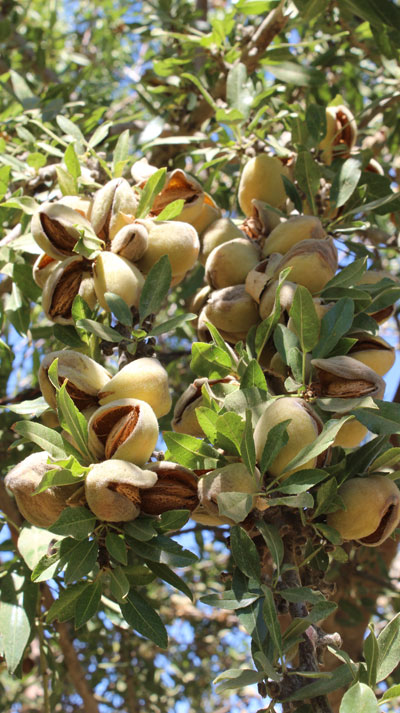
California farmers supply 82 percent of the world’s almonds. (Photo: Thuy Phan/Nguoi Viet)