By Ishaan Tharoor, Washington Post
My colleague Adam Taylor unpacked the recent events that reportedly spurred thousands of Vietnamese protesters to ransack foreign-owned factories in the environs of Saigon. Waving Vietnamese flags and chanting nationalist slogans, the demonstrators were enraged by China’s latest aggressive act: the placement of an oil rig not far from Vietnam’s coast, in waters contested by both Beijing and Hanoi.
An elderly Vietnamese protester holds a placard during an anti-China protest in front of the Chinese consulate in the financial district of Manila on May 16, 2014. Several hundred Filipino and Vietnamese protesters united in a march in the Philippine capital on May 16, demanding that China stop oil drilling in disputed South China Sea waters. (Photo TED ALJIBE/AFP/Getty Images)
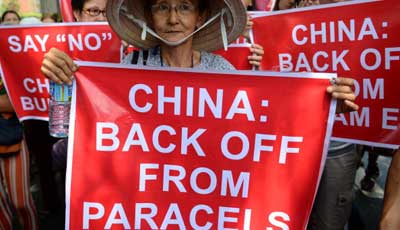
“Our patience has limits,” a 74-year-old war veteran told Agence France-Presse, outside the Chinese embassy in Hanoi. “We are here to express the will of the Vietnamese people to defend our territory at all costs. We are ready to die to protect our nation.”
Conspicuously, the Vietnamese government–one which routinely stifles dissent and muffles civil society at home–appears to have sanctioned some of the protests. The country’s Communist rulers walk a delicate tightrope, compelled both to manage a pivotal relationship with its larger, far more powerful northern neighbor, while also reckoning with the burgeoning anti-Chinese sentiments of its population.
China isn’t making Vietnam’s hand any easier to play. In recent years, the longstanding Sino-Vietnamese rivalry over disputed archipelagos in the South China Sea has flared, as an increasingly assertive China expanded its navy and pushed its maritime claims.
The tensions between the two countries belie a shared ideological and cultural past. For centuries, parts of Vietnam existed under the suzerainty of Chinese dynasties. By the mid 20th century, as the Vietnamese struggled to overthrow French colonial rule, Vietnam’s revolutionaries received aid and support from Chairman Mao Zedong’s People’s Republic of China.
But things turned after the conclusion of the U.S.-Vietnam War, when the Vietnamese moved solidly into the Soviet camp, antagonizing Beijing, which had warmed to the United States and also helped prop up Pol Pot’s murderous Khmer Rouge regime in neighboring Cambodia. When Vietnam stepped in at the end of 1978, overthrew the Khmer Rouge and effectively ended the hideous Cambodian genocide, China found reason to retaliate.
The brief, bloody war that followed in 1979 — then Chinese leader Deng Xiaoping said he wanted to teach the Vietnamese “a lesson” — achieved little but a ruinous loss of life. In the first few days of combat alone, some 4,000 invading Chinese soldiers, thrown at Vietnamese lines in “human waves,” were killed. Tens of thousands died on both side, with both Beijing and Hanoi claiming Pyrrhic victories.
Read the full article by Ishaan Tharoor from Washington Post.