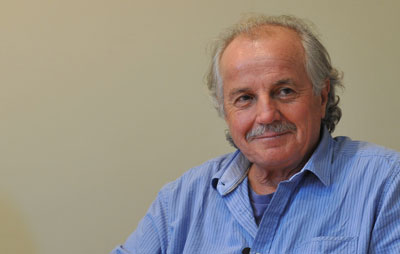
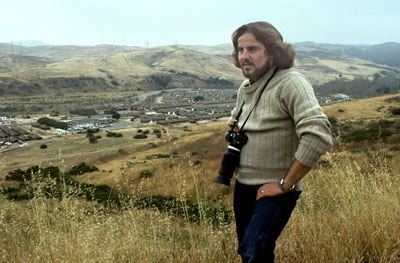
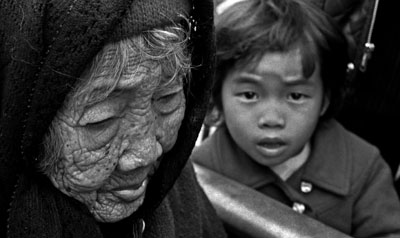
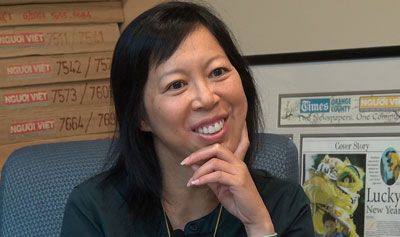
Thuy Phan & Do Dzung/Nguoi Viet Westminster, Calif.–As a young soldier stationed in Vietnam in 1971, Don Bartletti bought his first Nikon camera for just $85, from the Army Post Exchange store, thinking it could keep him busy during his off time. With a fledgling eye for photography, he took his Nikon camera and snapped photos of the lush mountain landscapes, vibrant green rice paddies, and the faces of people he encountered along the way. “That’s where I learned to really appreciate people,” said Bartletti. “I was there as a soldier but I didn’t want to take pictures of casualties and the ugly side of war. I wanted to capture the beauty and humanity of the people. It’s where I realized we are all the same.” Don Bartletti, 40 years ago at Camp Pendleton. (Photo: Courtesy Don Bartletti) That beginning, and personal realization led Bartletti to an illustrious career spanning 30 years at the Los Angeles Times as a photojournalist. In 2003, Bartletti earned a Pulitzer Prize for a photo essay he documented about the plight of young South American immigrants and their harrowing journey as stowaways aboard trains. But it is on June 12, 1975 that the story of one of his subjects begins. It was after the Americans had pulled out of Saigon, and the first wave of Vietnamese refugees poured into Camp Pendleton, and Bartletti, then a photojournalist for The Vista Press, took a series of photos documenting the arrival of immigrants. “I knew it would be an important part of history and I wanted to be there to capture it,” Bartletti said. One photo in particular, stood out. It features an extreme closeup of two people: a wrinkled, weather worn 109-year-old Vietnamese woman sitting in her wheelchair and her 5-year-old great-granddaughter standing next to her. The picture that launched a nationwide search for the little girl’s identity 40 yaers later. Bartletti snapped this photo of 109-year-old Tran Thi Nam and her 5-year-old great-granddaughter Ha Hoang in 1975 at Camp Pendleton. (Photo: Don Bartletti/ The Vista Press) “The contrast between the two was unmistakable,” said Bartletti.”They’re like opposite bookends of life. You have the young, porcelain skinned, beautiful child. And her great-grandmother, with her whole life etched into her skin. I still think this 109- year-old woman, is the most beautiful woman I have ever seen.” He explained he felt that way, not because of the cliché of beauty and what advertisements want us to associate with beauty but because she of the way she held herself and perservered. “She was proud,” he said. “She lived. And she survived so many tensions in life. And she still had the courage to get on a boat. And then get on a second boat. To be with her family at Camp Pendleton. That’s beauty.” That photo of Tran Thi Nam and her great-granddaughter made the front page of the The Vista Press and Bartletti remembers making a print of that photo to give to the family. He brought it to Camp Pendleton and entrusted it to an officer, not knowing if it ever landed in their hands. He went on with his life, as did the 10,000 refugees who landed there on the shores of San Diego after the war– thrust into a new, strange land, unsure of what was to come, but unable to do anything else but move forward. 40 years later Fast forward to now, and another former Vietnamese refugee comes into the picture. Anh Do, a writer for the Los Angeles Times, and now colleague of Don Bartletti, wants to find the little girl in that picture and enlists the help of Nguoi Viet Daily News. The paper runs the photo with a plea for anyone knowing the identity of the little girl to contact Do. “It was a case of someone recognizing someone and that someone contacting someone else,” Do said. Anh Do, a writer for the Los Angeles Times, asked for Nguoi Viet Daily News’ help in locating the little girl in the photo and found her. (Photo: Dan Huynh/Nguoi Viet) As she recalled, a gentleman named Tam called her from Port Arthur, Tex., saying his uncle recognized the girl in the picture and asked him to reach out to Do. Tam, who is a distant relative of the young girl Do was looking for, said he wasn’t close; however, he was close to her sister, who lives in New Jersey. Do then reached out to the sister, and was one step closer. From there, she was given the number of an aunt, who lives in Fresno, Calif. Through conversations with the aunt, Do was finally given the contact information of the little girl, who was no longer little, but now a 45-year-old nurse practitioner and married mother of one. And Do now had a face to the name: Lisa Ha Nishihara. The Reunion Once Do found Nishihara, she knew she had to meet her in person. Together with Don Bartletti, who took that photo 40 years ago, and Don Kelsen, another former Vietnam War veteran and Los Angeles Times photojournalist in charge of filming the interview, they set off to Fresno and to meet Nishihara. Kelsen, who also happened to be at Camp Pendleton in 1975, said it was serendipity that all three ended up together on this project. Don Kelsen, a former Vietnam War veteran and LA Times photojournalist, produced the video on the the story of Lisa Ha Nishihara. (Photo: Dan Huynh/Nguoi Viet) “I didn’t know that Don was in the war and that he had been at Camp Pendleton,” said Kelsen. “And he didn’t know I was either, and that we both had photographic evidence that we could trace back to that day and revisit when we did this story. Because of our history, and Anh’s, it worked out nicely for all three of us to be involved.” Nishihara said she really didn’t believe reporters from the LA Times were coming until they were there in her living room that it became real. “It was very emotional,” said Nishihara. “There are no words to describe it. It was so sad when we left our country and it was a struggle, so it brings back memories.” Nishihara, born Ha Hoang, changed her name to Lisa and took her husband’s last name. She has a 12-year-old daughter named Summerrose and lives in Fresno, where most of her family resettled after they left Camp Pendleton. Seeing Bartletti after all these years brought back a lot of good but painful memories of both Vietnam and Camp Pendleton. “She was always there for us,” said Nishihara of her great-grandmother. “If it weren’t for her and my grandfather, we’d be lost. Everyday I went to school, she gave us money to spend and I was not a good student. I always got spanked everyday. But it was her that instilled in me that I had to go to school and study hard, and I truly believe that’s why I’m where I’m at today.” One coincidence that Nishihara feels helped to make this meeting unique, happened when she told the LA Times crew she had a photo to show them and went upstairs to retrieve it. When she came back down, in her hands she held a framed, black and white photo. One that Bartletti knew very well– it was the one Bartletti had taken and made a print of all those years ago. He was stunned. “I could tell by the coloring and fading it was the original prints I made,” he said. “It made it to the family after all.” Coming full circle For Bartletti, finding and meeting Nishihara was a rare chance to return to a time and subject that he doesn’t always have the luxury of doing. Don Bartletti, who took the photo of Nishihara and her great-grandmother 40 years ago, recounts his meeting with Nishihara at Nguoi Viet Daily News. (Photo: Dan Huynh/Nguoi Viet) “As photojournalists, we tend to snap the photo and move on,” he explained. “This photo gave all three of us the chance to ask, “What happened in the last 40 years?”. And now as an adult, she answered what happened.” While Do remains humble about the impact of the story she wrote, Bartletti is sure her perspective as a former refugee added an extra layer of depth that an American writer could not have imparted. “No one could have written this story but Anh, because she has the perspective of knowing the story intimately because she lived it,” he said. The team also brought with them a copy of the newspaper that featured Nishihara and her great-grandmother to show her, correctly guessing she never knew it existed. Her stunned, teary and emotional response to seeing it plastered on the front page affected Bartletti and left an impression. “I think until she saw that paper, that all those 40 years she didn’t think that her experience mattered to anyone,” explained Bartletti. “So when it was in the newspaper, which is a recognized diary of important things that happened in the world, she realized that, “Wow, I was somebody. I really was somebody and my great-grandmother was too.” His voice broke as he continued, “And she said she wished her father could have seen it– he would have been so happy.” — Thanks to Do’s story and the reunion with Bartletti, Nishihara was inspired to learn more about her roots and for the first time, attended the Black April commemoration ceremony held at Bolsa Grande High School with her family. It was supposed to be held at Camp Pendleton but was moved becuase of U.S. laws prohibiting the display of a flag of an unrecognized country to fly on federal land, meaning the South Vietnamese flag could not be present. “It would have meant more if it was held at Camp Pendleton,” she said. “But it was still meaningful and emotional.” Nishihara said because of this whole experience she is considering going back to Vietnam for the first time to visit her roots and to see how it’s changed. “That’s one gift Don gave me that will impact me for rest of my life,” said Nishihara. “Its like a complete circle. I thank him a lot and really, what words can you possibly say to thank him? He changed my life.” == To contact the writer: [email protected]

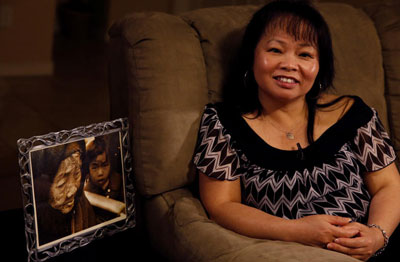
Lisa Nishihara sits in her living room next to the original photo Don Bartletti took 40 years ago. (Photo: graphics.latimes.com)