From WIRE REPORTS
Parents come to a primary school in Ha Noi to pick up their children after their entrance exams. WIRE PHOTO.
The race to gain admission to first grade in Ha Noi is intense this year as babies born in the lucky Year of the Pig in 2007 reach school age.
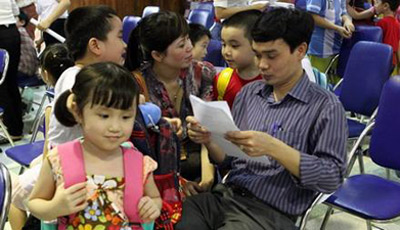
For the school year beginning in September, children now are being forced to take entrance exams in several schools to ensure admission.
Earlier, many parents spent hundreds of dollars to send them to preparatory courses; Viet Nam’s 2012 income per capita was $1,555. Many public schools have announced they only have place for as few as 25 percent of the applicants.
The head of the primary school section at the city Department of Education and Training, however, said there is place for all of them though there are 11,000 more candidates this year. Still, because of a clamoring for admission to some of the more prestigious public schools, the department has allowed them to hold tests to measure language (including English) and mental ability.
The Ministry of Education and Training had in the past banned primary schools from testing children’s reading and writing skills before they enter school. Given that, children are sent to preparatory courses costing at least $288, in addition to learning at home from their parents.
Doan Thi Diem Primary School in Tu Liem District, for instance, has courses for preschool children in logic, English and other subjects.
A woman named Quynh Anh said she paid about $200 for her daughter’s 12-day course. The child was among nearly 1,000 children attending 30 different courses at the school.
Pressure on
Schools blamed parents for wanting their children to study in famous schools, thus forcing the schools to put pressure on the children since they cannot take all of them in.
Regulations require schools to admit all children living in their neighborhood. Besides knowledge, some schools even test the children’s dancing and singing skills, and physical health, thus keeping them in school for a whole day.
Understandably, many children are cranky, crying through the tests and often not performing as well as they did at home.
Thuy, a woman whose daughter took tests at three different schools, said: “My child was so anxious she did not do well in the test. Not all children can do the test properly with this kind of tension.”
She is taking her child for another course in addition to hiring a tutor at home to prepare her for another test this month.
A man named Tuyen expressed frustration that children do not do well on the tests but are forced to put up with the system.
“I don’t want him to be haunted by failure,” he said of his son.
Mai Ngoc Luong, former director of a research center for pre-university education at the Sai Gon Education University, said taking exams is already a haunting experience for children. “Let them enjoy a gentle and cheerful childhood like they are supposed to.”
A WikiLeaks cable on Vietnamese education, sent from the U.S. Embassy in January 2010, said: “…The Vietnamese educational system is widely regarded as being in crisis at all levels… Teaching methods remain too passive, with students having little chance to interact with the teacher, discuss issues or ask questions.”
A rising number of the nouveau riche, as well as some middle- and upper-income middle-class families in Viet Nam, are opting to send their children abroad for higher studies. Experts say they are “escaping” an education system that is rigid, of suspect quality and riddled with scandals in recent years.
In 2010, Transparency International’s Global Corruption Barometer for Viet Nam found that education was perceived as the second-most corrupt sector.