By Tom Gilbert, NPR
Looking back on my history with Latino and Caribbean food, I can see that Cuban was a gateway cuisine. Powerless in my youth before moro rice (black beans and rice cooked together) and ropa vieja (shredded flank steak slow-cooked in a tomato-based sauce), in middle age I became hooked on the spicy and soulful cooking of the wider Caribbean, which led to eating adventures even farther south of Key West. All of these have left their mark on my backyard grilling style.
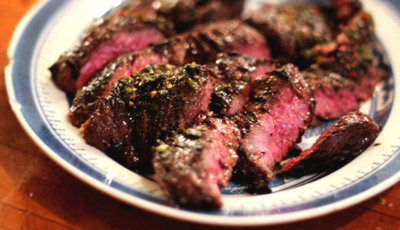
Grilled, Marinated Skirt Steak With Chimichurri Sauce
It started not with a trip to Cuba or Miami, but with a subway ride to the Upper West Side of Manhattan. This was a long time ago, and there used to be many restaurants there that advertised comida china y criolla, or Cuban-Chinese food. At first glance, this might seem to be the world’s unlikeliest food fusion idea, but if you think about it, the two cuisines have some degree of overlap — rice and seafood, chilies and garlic, limes and cilantro, the centrality of pork, black beans and black bean paste, empanadas and won tons.
The reality was that the Chinese food at these places was dreadful. The Cuban food was mediocre at best, but for me it was a revelation. I had my first batido, a shake made of fresh tropical fruit, milk, sugar or cane syrup and ice, put through a blender. You could get batidos made from papaya and mango, and exotic (to me) flavors such as mamey and guanabana. I developed a passion for earthy black beans and Cuban sandwiches and pork shoulder roasted until you could carve it with a butter knife and its perfect partner, maduros (pan-fried ultra-sweet plantains). I can still taste the café con leche.
I followed my stomach across the Hudson River to Union City, N.J., where Bergenline Avenue ran through the center of the largest Cuban-American community outside of Florida. These were the good old days, when you could light up a cigar after dinner in a restaurant, at least in Union City. (One Cuban place had a sign reading: “Thank You for Smoking”). Today, the Cuban community is dwindling, and the state has all but driven the cigar shops out of existence, but you can still find great food — not all of it Cuban. Thanks to the American cycle of assimilation and immigration, Union City and surrounding areas have become more multicultural and more multiculinary. Puerto Rican pasteles, Dominican mofongo and Salvadoran pupusas are crashing the party.
This reflects a trend that is evident even in Cuban-dominated Miami. When I traveled to Miami in the 1980s and 1990s, I came in search of the El Dorado of Cuban cuisine — and no doubt found it — but Miami surprised me by widening my eating horizons to include Argentinian grills and Jamaican jerk places and Haitian barbecue joints. These cuisines co-exist, but they also interact, as kitchens and menus cross-pollinate. This makes profound sense — a lot more sense than Cuban-Chinese food — because Caribbean and Latino cooking are already fusion cuisines, with roots in Spain, Africa, the New World, the Canary Islands and even the Middle East.
In Miami, I had chimichurri sauce — the classic Argentine accompaniment to grilled beef — for the first time (oddly enough, at a Nicaraguan place), which I remember the way most people remember their first kiss. Unlike young love, however, the joy of a good steak with chimichurri — maybe with some rice and beans and maduros on the side — can be rediscovered and relived forever.
Read the full article and get the recipes by Tom Gilbert from NPR.