By Carl Thayer, The Diplomat
Last month the United States and Vietnam held two important annual high-level security meetings in Washington: the 6th Political, Security, and Defense Dialogue and the 4th Defense Policy Dialogue.
United States Marines
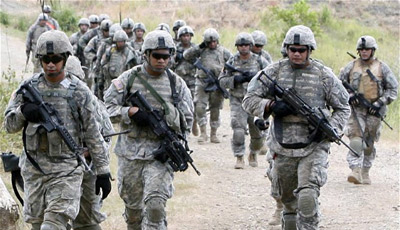
The 6th U.S.-Vietnam Political, Security and Defense Dialogue was held on October 1 at deputy minister level. The U.S. was represented by Acting Assistant Secretary of State for Political-Military Affairs Tom Kelly, and Vietnam was represented by Deputy Foreign Minister Ha Kim Ngoc.
This dialogue has a wide-ranging agenda that touches on the full-spectrum of political, security and defense issues of concern. This is reflected in the composition of the representatives that attend.
The U.S. delegation included representatives from the Department of State, Department of Defense, Agency for International Development and the U.S. Pacific Command. The Vietnamese delegation included representatives from the Ministry of Foreign Affairs, Ministry of Public Security and Ministry of National Defense.
The agenda for the 6th U.S.-Vietnam Political, Security and Defense Dialogue included counterterrorism, counternarcotics, human trafficking, cyber, law enforcement, defense and security, disaster response, search and rescue, war legacy issues and cooperation in regional organizations such as ASEAN, the ASEAN Regional Forum and the East Asia Summit.
The 4th U.S.-Vietnam Defense Policy Dialogue is also held at deputy minister level and involves officials from their respective defense ministries. The fourth dialogue was held in Washington on October 28-29. The U.S. was represented by Deputy Assistant Secretary of Defense for South and Southeast Asia Vikram Singh, and Vietnam was represented by Deputy Minister for National Defense Senior Lt. Gen. Nguyen Chi Vinh.
Both dialogues were held within the framework of the Memorandum of Understanding on Advancing Bilateral Defense Cooperation signed on September 19, 2011 and the U.S.-Vietnam Joint Statement of July 25, 2013.
The 2011 MOU set out five priority areas for bilateral defense cooperation: regular high-level dialogues between the Department of Defense and the Ministry of National Defense, maritime security, search and rescue, humanitarian assistance and disaster relief and peacekeeping. The MOU, in fact, was a codification of activities that were already being carried out. The MOU was also a transparency measure designed to mitigate – to the extent possible – Beijing’s fears of U.S.-Vietnam military collusion against China.
The U.S.-Vietnam defense dialogues are conducted in the shadow of Vietnam War era legacies. Vietnam uses these occasions to announce progress in the search for American service personnel Missing in Action (MIA). For example, during the June 2012 visit to Hanoi by Secretary of Defense Leon Panetta, Vietnam announced that it was opening three new sites for MIA searches. This statement came on the eve of the 5th Political, Security, and Defense Dialogue . At the 2nd U.S.-Vietnam Defense Policy Dialogue in September 2011 Vietnam handed over six dossiers related to MIA searches.
Washington uses the occasion of defense dialogues to reaffirm continuing commitment to clearing up Vietnam War era unexploded ordnance and the toxic effects of Agent Orange. At the 2nd Defense Policy Dialogue, for example, the U.S. stated that it would continue to assist Vietnam in overcoming the “aftermath of war,” a euphemism for unexploded ordnance and dioxin poisoning.
U.S.-Vietnam defense cooperation under the 2011 MOU has proceeded at a cautious and gradual pace. Just prior to the signing of the MOU the first U.S. Military Sealift Command vessel underwent minor repairs in Cam Ranh Bay. Four other Military Sealift Command vessels were serviced there after the MOU was signed. Each repair was valued at under half a million US dollars.
In October 2011 the commandant of Vietnam’s National Defense Academy addressed staff and students at the U.S. National Defense University. For the first time, Vietnam sent one student each to the U.S. National War College and the U.S. Naval Staff College.
From June to August 2012, Vietnam sent its first observer to the Rim of the Pacific Exercise (RIMPAC). In July 2012, the U.S. hosted Vietnam’s Steering Board 501, which has responsibility for dealing with unexploded ordnance. In October of the same year, the USS George Washington aircraft carrier hosted a fly out by a delegation of Vietnamese officials in international waters off Vietnam’s eastern coast.
In 2012, Vietnam hosted visits by a number of senior U.S. officials, including the Commander of the U.S. 7th Fleet (January); Panetta (June); the Commander of the US Pacific Fleet (July); and a delegation from the U.S. National Defense University (October). In April, Vietnam hosted the third naval exchange activity in the port of Da Nang involving salvage and disaster training but no live-firing exercises or exchange of combat skills.
In 2013 Vietnam hosted the 3rd Defense Policy Dialogue in January and the fourth non-combat naval exchange activity in Da Nang the following April.
Read the full article by Carl Thayer from the Diplomat.