By Sunshine de Leon and Barbara Demick, Los Angeles Times
Filipinos in devastated Tacloban try to rush military planes to evacuate, and relief crews struggle to get aid through the debris.
MANILA — Drenched by rain and increasingly desperate, typhoon-stricken Filipinos rushed fences and pleaded with guards Tuesday at the battered airport serving as a tenuous lifeline to an international aid effort confronted at every turn by transport and logistics bottlenecks.
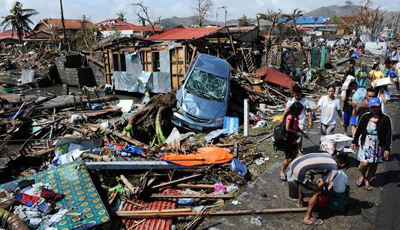
The Philippine city of Tacloban is left in ruins by Typhoon Haiyan. (Ted Aljibe / AFP/Getty Images / November 10, 2013)
The United Nations launched an appeal for $301 million to help victims. The chief of its humanitarian operations, Valerie Amos, arrived in Manila, the capital, to coordinate the relief effort and quickly acknowledged the difficulties it faced.
“We have not been able to get into the remote areas,” Amos said. Even in Tacloban, she said, the main city in the typhoon’s path and the site of the airport, “because of the debris and the difficulties with logistics and so on, we have not been able to get in the level of supply that we would want to.”
In its appeal for funds, the U.N. estimated that more than 11 million people had been affected by Typhoon Haiyan, one of the strongest storms ever to hit land, with 660,000 left homeless. The official death toll was nearly 1,800, and that figure is expected to rise substantially. More than 2,500 were injured.
Philippine President Benigno Aquino III downplayed widespread estimates that 10,000 or more people might have died, telling CNN that the figure was more likely 2,000 to 2,500 people.
The higher estimate came from local officials soon after the storm swept through early Friday, and may have been the result of “emotional trauma,” Aquino said.
Still, it’s clear that relief workers have not yet reached many outlying communities, and that it’s proving difficult to move supplies from airfields and ports even into the main cities.
Tacloban’s airport is the only major airfield on the hard-hit island of Leyte. Aid workers say the road from the airport into the city is so clogged with debris and the putrefying remains of the dead that the trip takes three hours. Roads leading inland are impassable.
Amos said money was needed for “food, health, sanitation, shelter, debris removal and also protection of the most vulnerable.”
Read the full story by Sunshine de Leon and Barbara Demick from Los Angeles Times.