By Edward Miller, New York Daily News
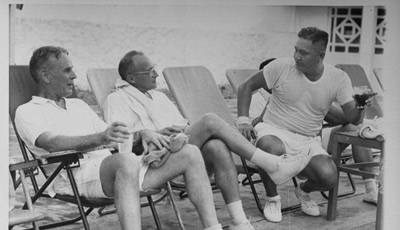
Gen. Duong Van Minh, Ngo Dinh Diem and Gen. Mawell Taylor in Saigon in 1963.
As Americans mark the 50th anniversary of John F. Kennedy assassination’s this week, they would do well to recall the death of another president in November 1963. Ngo Dinh Diem, the founding leader of the anti-communist state of South Vietnam, was murdered during an army coup in Saigon, just three weeks before Kennedy met his fate in Dallas.
The story of Diem’s downfall is replete with both historical irony and tragedy. Although Kennedy approved the coup, he did so amid grave uncertainty over what course to take in Vietnam and despite his personal admiration for Diem.
Kennedy’s decision to encourage the 1963 coup was a dramatic reversal of America’s long-standing support for Diem. For nearly a decade, Washington had furnished Diem’s government with extensive aid and expertise. During an official visit to the U.S. in 1957, Diem was hailed as the “miracle man” of Southeast Asia, a model Cold War ally who had saved his country from communism.
In 1961, Kennedy actually expanded U.S. assistance to South Vietnam in response to the growing strength of the Viet Cong insurgency. At first, this increased aid appeared to have the desired effect as the South Vietnamese army inflicted several defeats on the rebels. But in 1963, Diem’s brutal crackdown on an anti-government protest movement led by Buddhist monks prompted Kennedy to green-light the coup. What had gone wrong?
The deeper roots of the 1963 crisis — and Kennedy’s decision for regime change — lay in a clash of ideas about nation building. Many commentators have mistakenly portrayed Diem as an American puppet or as a tradition-bound mandarin who had no interest in development or modernization. In fact, Diem had elaborate nation-building plans for South Vietnam. He pursued those plans zealously and ruthlessly, even when they contradicted U.S. advice.
Despite his authoritarian style of rule, Diem’s nation-building agenda appeared to succeed during his first years in power. His greatest triumphs came in the arena of state building. After winning a rigged election in 1955, Diem proclaimed the formation of a new Vietnamese republic, promulgated a constitution and launched security operations that briefly eliminated the communist party as an effective force in South Vietnam.
But nation building is never only about building state power. It also hinges critically on identity building — that is, on persuading ordinary people and groups to identify with state institutions. In this area, Diem was far less successful. His agrarian development programs were undermined by coercion and rampant corruption.
Meanwhile, harsh security policies created widespread fear and resentment in rural areas that the communists were quick to exploit. Diem’s high-handed approach to nation building also alienated many of his fellow anti-communists, including army commanders, Buddhists and other former supporters.
Read the full article by Edward Miller from New York Daily News.