By James Doran, The National
I was on a tiny island off the coast of Vietnam when typhoon Haiyan began to roar its way towards the Philippines last week. Phu Quoc is in the Gulf of Thailand, well out of the storm’s path, but a deep tropical depression that preceded it by 24 hours set nerves jangling and put Vietnam on high alert.
A resident gets water from a hose along a road blocked by debris, brought at the height of super typhoon Haiyan in Palo, Leyte province in central Philippines November 12, 2013. Reuters
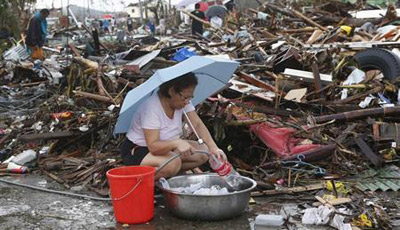
We were lucky, some heavy rain and high winds passed over Phu Quoc in the middle of the night, causing little upset besides the usual deep water-filled ruts on red clay roads and some escaped cows seeking refuge from a flooded field.
The morning after, though, as I wandered the shoreline of Ong Lang Beach, a kilometre-long stretch of sand about 10 metres in width from the edge of the mangrove to the water, a hint of devastation many miles over the sea lapped in the surf.
The normally pristine beach was lined with flotsam and jetsam hurled into the waves by the storm. Palm fronds, pieces of tree trunk and tonnes of mangrove formed the bulk of it.
But tangled in the vegetal mass were hundreds of old shoes. Flip- flops, sandals, some sneakers and the occasional Croc washed up to the delight of Phu Quoc’s crab population, which explored them with vim.
It was as if a container ship filled with cheap footwear had gone down in the storm. Perhaps it had.
More likely, though, was that these sad, unpaired shoes were evidence of lives torn apart by Haiyan. For each had once held a foot which, one can presume, once belonged to a person whose belongings had been washed out to sea as the high winds ravaged towns, villages and farmsteads. Perhaps some of the shoes’ owners had been washed out to sea with their belongings.
The following day, after Haiyan had finished ripping through the central Philippines, yet more detritus washed up, including a landline telephone, a school desk, yet more shoes and hundreds of plastic seasoning packets of the kind commonly included with instant noodles.
After three days of this oceanic vomit, the sea’s stomach settled and the flow of garbage ceased.
But as the water cleared, so the clean-up and the accounting began across the Philippines.
Super Typhoon Haiyan, as the storm is now known, is thought to have been one of the strongest to make landfall in history. We will probably never know if the claim is true, as calculating wind speed and measuring barometric pressure were presumably not a priority for those in its 40km-wide path of devastation.
In all, the destruction across the Philippines is expected to cost insurers as much as US$700 million, a fraction of the estimated $14.5 billion in damage because so few people are covered.
Sadly, this is nothing new for the Philippines. Every year the country is hit time and again with storms that not only destroy lives and livelihoods but also set political and economic progress back by decades.
And such storms are arriving with greater frequency and ferocity.
Read the full article by James Doran from the National.