By Tom Engelhardt, Huffington Post
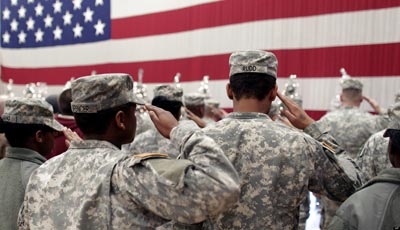
U.S. military. photo from The Associated Press.
Col. Manners Answers Your Questions on the Etiquette of War, Nuclear Threats, and Surveillance.
Dear Col. Manners,
I’m a 17-year-old high school student with an interest in American records. After college, I’m hoping to land a job with Guinness World Records. So here’s my question: I notice that news reports regularly refer to the Afghan War as the “longest in American history.” How is that possible? The war began in October 2001 and it’s now December 2013. Counting on my fingers, I get 12 years. The Vietnam War began in 1961 and didn’t end until 1975 (with those famous images of helicopters going over the side of an aircraft carrier). That’s 14 years by my count. I’m proud of American records of every sort, but this doesn’t seem like one. What am I doing wrong?
Proud in Toledo
Dear Proud,
You have a lot to be proud of and, as far as I can tell, you have just the right number of fingers. It’s true that, historically, we’ve been numero uno among record-breaking countries. Still, sometimes we get a little overeager. This is one of those cases. Clearly, those claiming the much desired “longest” title for Afghanistan are cheating by counting the Vietnam War as starting in 1964 with Congress’s Gulf of Tonkin resolution, or 1965 when the first official U.S. combat troops entered that country, not in 1961, when significant numbers of armed “advisors” initially arrived.
But don’t lose hope! Let me offer you some future numbers to be proud of. After all, at this moment the Obama administration is negotiating to keep 8,000 -15,000 of our troops in Afghanistan as trainers and to hunt al-Qaeda until 2024 (“or beyond ,” as some reports say). If, despite the machinations of that country’s emotionally unhinged president, they succeed… well, you can do the math yourself. That’s a 23-year war, so put it in the American record books — and by a long shot.
But don’t stop there. After all, the U.S. fought the Soviets in a fierce proxy war in Afghanistan from 1979 to 1989. I don’t know Guinness World Records rules, but if that decade is admissible, you’ve just left the 30-year war of the Vietnamese against the French and the Americans in the trash heap of modern records, and the European Thirty Years’ War of the seventeenth century in the dust. I won’t claim that somewhere there hasn’t been a longer war, but this would still be one for the global record books. And keep in mind that all of this has taken place in the landlocked backlands of the planet, a place most Americans couldn’t have located on a map before 1979.
Or let me put it this way and be a proud grandpa while I’m at it: my granddaughter Edna was born in October 2001. Before 2024, if all goes well, she could have at least three tours of duty in Afghanistan! So I say: 2024 or bust!
Yours in American Pride,
Col. Manners
***
Dear Col. Manners,
What’s up with the Obama administration and Afghanistan? If even Afghan President Hamid Karzai doesn’t want us in his country, and if, as he said recently, he still doesn’t “trust ” us, why should we want to stay? And if his compatriots are now ready to play the role of the Taliban and bring back stoning to death as a punishment for married adulterers, can you tell me: What is it that keeps us there?
A Puzzled Ohioan
Dear Puzzled,
Be puzzled no longer. The answer is simple. Just ask yourself: Who wants to be the president to “lose” Afghanistan? Not Barack Obama, I’ll wager. And keep in mind that, whatever the fears of presidents, the globe’s great power can’t be losing countries anyway. It makes for nasty domestic politics and a messy planet. If you lose one country, who knows how many others you might misplace in the ensuing panic?
Note as well that we’ve already been on an ominous, more-than-six-decades-long losing streak: there was China in the 1940s, half of Korea in the early 1950s, all of Vietnam in the 1970s, and now possibly Afghanistan. (Somehow, Iraq didn’t count. I’m only speculating, but it might have been misplaced from the start, which would help explain why no one noticed when we finally left.)
Sincerely yrs,
Col. Manners
***
Dear Col. Manners,
I’m sorry to bother you and embarrassed to ask you about this, but I was confused by something the other day. According to a spokesman for Afghan President Hamid Karzai, Secretary of State John Kerry offered to deliver a letter of apology, possibly signed by President Obama, for “past mistakes ” made in the Afghan war, including the killing of civilians. It was to be part of ongoing negotiations for a future security pact. Soon after, National Security Advisor Susan Rice said , “No such letter has been drafted or delivered. There is not a need for the United States to apologize to Afghanistan.” Not long after that, Kerry, too, swore that no apology had ever been on the table or was forthcoming.
If I make mistakes, I apologize. What’s wrong with the U.S. government doing the same?
Confused and Apologetic in Tucson
Dear Confused and Apologetic,
I’m glad you asked. The political etiquette of apology is straightforward enough and easy to grasp. Individually, we are expected to apologize for mistakes we make or pain we cause others. That’s a matter of human decency. Collectively, however, Americans don’t apologize. That is a reality all but written into the Constitution and a matter of American decency.
Regular countries, like regular people, are obliged to say their sorry. You invade your neighbor, for instance, and an apology is indeed in order. With an exceptional superpower, however, it’s another matter. For Washington to apologize, whatever the issue, would be like the guest of honor at a formal dinner arriving in jeans. Nobody would ever forget it or think well of you again. In fact, any great power that apologized would experience an instant devaluation of the currency that every pundit in Washington agrees is the single most important on this planet: credibility. You may not be able to bank it, but you sure can lose it.
Admittedly, we don’t know the details of what our secretary of state might have said or promised to the Afghan president, but if it was an apology, then he stepped over a real “red line ” in American politics.
An apology to the Afghans would be a) absurd (it’s the Afghans!) and b) humiliating (it’s the Afghans!). American credibility would suffer a blow from which it would be unlikely to recover. And imagine what a post-apology world would be like: no country could ever again count on us to travel enormous distances, invade their land, and occupy them.
Yours unapologetically,
Col. Manners
***
Read the full article by Tom Engelhardt, Huffington Post.