By Michael Matza, Inquirer
PHILADELPHIA – When Dien Binh Chau, a naturalized citizen, went to his polling place in South Philadelphia recently, he needed help understanding the ballot. With no municipal interpreter present, poll workers turned to a stranger on the street, who just happened to speak Vietnamese.
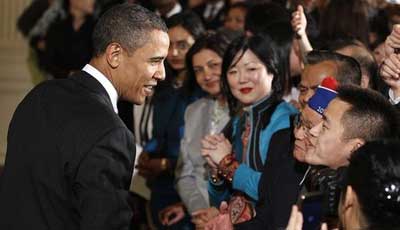
President Barack Obama greets the Asian community. PHOTO: AP
When Wei Shong Lui showed up at a Chinatown church to cast a ballot, his name wasn’t on the rolls. Rather than tell him his correct polling place, workers turned him away.
Chau and Lui are among a dozen recent examples compiled by voting-rights advocates who say about 57 percent of foreign-born Asian Americans in Philadelphia have limited proficiency in English and are entitled to special assistance that many are not receiving.
On Wednesday, a coalition of advocacy groups, including Boat People-SOS of the Delaware Valley, the Asian Pacific American Bar Association of Pennsylvania, and the Asian American Legal Defense and Education Fund (AALDEF), are expected to file an antidiscrimination complaint with the city’s Human Relations Commission.
The complaint, a copy of which was obtained by The Inquirer, says the Board of City Commissioners, which supervises elections, has routinely violated the city’s Fair Practices Ordinance by not providing adequate language assistance in areas where it is needed: for Koreans in North Philadelphia; Vietnamese in South Philadelphia; Chinese in Center City; and Cambodians in parts of Olney and South Philadelphia.
“Even though they are duly registered [to vote], they are not being accommodated,” said Jerry G. Vattamala, one of the AALDEF attorneys who drafted the complaint. “We have communicated to the commissioners the great need, [and] they have decided to do nothing.”
Even though some naturalized citizens were required to pass a basic literacy test to obtain U.S. citizenship, those with limited proficiency “face serious difficulties … understanding the ballot, knowing how to operate the machine, and understanding how to correct a ballot,” according to the complaint.
Others who were naturalized were legally exempt from the literacy test because of their advanced age.
Read the full article by Michael Matza from Inquirer.