From The World Bank
Saigon, VIETNAM – In 1886, Nguyen Van Truong (also known as Jacques Cam), a young deaf man, returned to what is now Saigon after spending six years at the Rodez School for the Deaf in France. He took a tutoring position at the Lai Thieu School for the Deaf, the first of its kind in Vietnam, where he taught sign language to deaf children.
A World Bank-supported project has helped about 150 Vietnamese deaf children use sign language and get better prepared for school and life.
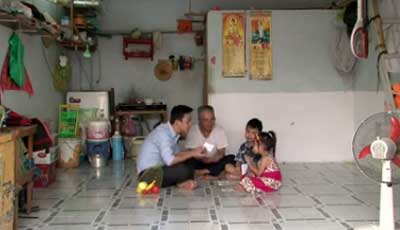
In 2014, deaf children at Saigon’s Center for Supporting and Developing Inclusive Education for People with Disabilities (CSDIEPD) are not just learning sign language. They are being taught how to understand the world around them and how to express themselves so they can be understood.
The center, along with five other centers in Saigon, Thai Nguyen, Quang Binh, and Hanoi, is testing an innovative method to improve the early development of deaf children. A “family support team”, made up of a deaf mentor, a sign language interpreter and a hearing teacher, work with young children in their homes, with their families. “This model offers a new way to help the children,” said Nguyen Thanh Tam, Director of the Saigon CSPIEPD. “We used to provide support at the center, but our facilities are limited. Now, we help 150 children in the center and another 170 children in their homes.”
Four-year old Linh Nguyen likes that teachers go to her house. “Teachers come to my house to teach me to sign. Today I learned about fruits and colors. They also teach my brother Tu, my grandfather, my father, and everyone else in my family.” Both Linh and Tu were born deaf.
Supported by the Intergenerational Deaf Education Outreach (IDEO) Project, which is financed by the Japan Social Development Fund, administered by the World Bank and implemented by World Concern, the model has three key features:
• Use sign language as the primary mode of communication, enabling deaf children to connect with their families and with the outside world;
• Have deaf mentors as role models, advocates and sign language teachers, because they understand “from the inside” the realities of growing up deaf; and
• Involve the family in the child’s learning and development.
The model brings together deaf adults, children and their families and, through a “family-centered, learner-friendly” approach, opens up communication to help the children realize their full potential.
Read the full article from The World Bank.