By Al Kamen and Colby Itkowitz, Washington Post
Vladimir Putin and President Obama will never be best friends, but the Russian president is fairly confident his counterpart would at least toss him a life buoy if he were flailing in open water.
Vladimir Putin. PHOTO: (AP Photo/RIA-Novosti, Alexei Nikolsky, Presidential Press Service
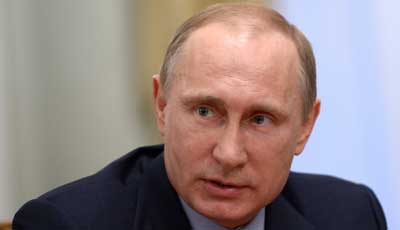
Near the conclusion of a marathon four-hour Q&A session on Russia’s RT television network, Putin read a question aloud from someone curious whether he thought Obama would save him from drowning. The question was met with laughter and applause.
Despite their strained relationship, Putin gave Obama the benefit of the doubt.
“In addition to intergovernmental relations, there are some personal relations,” Putin answered, according to the English translation from RT. “I don’t think I have close personal relationship with Obama. I think Obama is a courageous and good person and he would for sure save me.”
The Loop asked the White House whether it could confirm Obama’s hypothetical altruism. Shockingly, we got no response.
And Putin, let it be noted, was not asked whether he, if the circumstances were reversed, would save Obama.
A long way in a short while
Former U.S. ambassador Richard Hoagland, a career Foreign Service officer, spoke candidly at a gay-pride conference this week about the difficulties gay diplomats faced in the not-so-distant past.
Hoagland recalled an instance in the 1990s when his security clearance was taking a long time to be renewed, and he suspected it could have to do with concerns about his sexuality. He went to the head of diplomatic security and threatened: “You have no reason to deny my security clearance. I want it on my desk in one week, or I’m going to The Washington Post.”
(Not jumping to conclusions about where specifically he would have taken his grievances, but the Loop did start in 1993.)
Hoagland, currently the State Department’s principal deputy assistant secretary in the Bureau of South and Central Asian Affairs, discussed global human rights issues facing LGBT people during a speech at the Johns Hopkins School of Advanced International Studies. Where just 14 years ago it was considered “radical” to include the LGBT community in the larger conversation about human rights atrocities around the world, now it is a major part of the State Department’s platform, he said.
Still, Hoagland cautioned that the work of U.S. diplomats to promote gay rights abroad must continue, citing the U.S. government’s monitoring of the treatment of gay individuals in Uganda, Russia and India.
“This is an unfortunate truth: With about 80 countries worldwide criminalizing homosexuality, LGBT persons around the world remain vulnerable to arbitrary arrest, harassment, discrimination and violence,” Hoagland said. “Even today, five countries still define homosexuality as a crime punishable by death.”
Hoagland, who was U.S. ambassador to Kazakhstan and then Tajikistan, was a founding member of GLIFAA, the State Department group originally known as Gays and Lesbians in Foreign Affairs Agencies, according to an agency official.
Read the full article by Al Kamen and Colby Itkowitz from Washington Post.