From The Guardian
If you’re not familiar with these little delicacies – also known as fresh spring rolls – then my, you’ve got a treat in store. Cucumber granita aside, they’re just about the freshest thing I can imagine: a jumble of crunchy raw vegetables, soft, aromatic leaves and cool, squidgy noodles, all stuffed snugly into a featherlight rice wrapper.
Perfect Vietnamese summer rolls. Photograph: Felicity Cloake/The Guardian
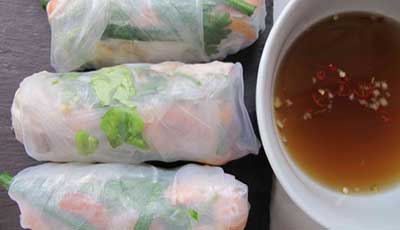
In fact, summer rolls were what first hooked me on the fresh flavours of Vietnamese cooking: so much lighter and punchier than the fried snacks I was expecting. Gourmet magazine’s description – “a salad packed into an edible container” – sums them up nicely.
Once you’ve mastered the basics, you can play around with the recipe to your heart’s content (and it ought to be content: many versions are very low in fat) – but the guiding principle should always be to cram as many contrasts of flavour and texture into each bite as possible, while retaining the roll’s elegant appearance (ie don’t get too Man v Food about it). But what’s the best way to start?
Meat
Rick Stein notes there are endless combinations of filling, but the most popular version online seems to be a prawn roll, with or without pork. Most recipes simply specify cooked prawns, but Van Tran and Anh Vu’s Vietnamese Market Cookbook briefly simmers them in lemongrass-infused coconut milk before use. The lemongrass is a nice touch, but I can’t taste the coconut – it’s more important, I think, to buy the prawns raw and poach them in salted water, as Vietnamese food writer Uyen Luu suggests, so they act as the savoury element in what’s otherwise a fairly sweet dish. Prawns in Vietnam tend to be big spiny monsters that are halfway to langoustine, but there’s no reason you shouldn’t use smaller north Atlantic prawns if you’d prefer – although the large, vibrantly coloured exotic versions do look prettier in the wrappers.
A number of the recipes also suggest adding pork, usually belly – cooked, as Luu and Stein suggest, by simmering the meat in salted water until tender, then thinly sliced before use. As well as making the dish more substantial, the meat, like the prawns, acts as a savoury balance to the other ingredients, while also adding a richness of its own. For a lighter dish, though, I’d leave it out.
(If you eat neither pork or prawns, Rosemary Brissenden’s recipe in South East Asian Food suggests chicken thigh as an alternative, or you can find plenty of vegetarian versions online, including the Gourmet recipe referenced here.)
The vegetables
Lettuce – the soft sort rather than crispy iceberg – seems to be the one constant in summer rolls, and the leaves are usually used whole as a layer in themselves, although Brissenden calls for them to be shredded before use, which I think gives the rolls a better texture. Gourmet, however, uses chinese cabbage instead, which I’m not keen on: it may be crunchier, but the slightly sulphurous flavour seems all wrong. Luu stops with lettuce, but most people stuff in a few more vegetables: Stein and Brissenden go for beansprouts, Tran and Vu shredded carrot, cucumber and, rather surprisingly, pineapple, and Gourmet carrots. Of course, Gourmet’s aren’t just any carrots – they’re tossed with lime juice and sugar before use, which makes the filling a bit mushy. It also spoils the intended contrast between the slightly bland, crunchy roll and the punchy dipping sauce. Pineapple isn’t too my taste either – too sweet – but otherwise I’m keen to pack in as many different textures and flavours as possible, with the exception of beansprouts, which, though pleasingly crunchy, don’t taste fresh enough for my liking.
The herbs
Herbs play a big part in Vietnamese cooking – they’re often used more like a salad leaf than a garnish, and in the summer roll it’s no exception. Tran and Vu keep things simple with just coriander, but everyone else goes a bit crazy. Garlic and chinese chives (which you may remember from our old friend pad thai) are popular – used by Brissenden, Stein and Luu – as is mint (Brissenden, Luu, Stein and Gourmet). Stein also goes for thai basil, while Luu suggests also adding cockscomb mint, perilla leaves and coriander, describing cockscomb mint as resembling “minty lemon balm” and perilla leaves as having “peppery, cinnamon and fennel flavours”. They take a little tracking down, cycling around London on the hottest day of the year, but I’m pleased I’ve done it: the perilla leaves especially add a really unusual, sweetly spicy taste to the rolls. If you can’t get them but have a big supermarket nearby then thai basil is a nice substitute, and works well with the slight soapiness of coriander and the freshness of mint. Don’t be tempted to substitute Italian basil if you can’t get either though; just leave it out.
Noodles
The only bulky element of this delicate dish – although rice vermicelli aren’t exactly pappardelle, they are surprisingly difficult to get absolutely right (again, see pad thai). The ideal texture, as far as I can tell, is yielding but still slightly chewy. Many recipes dodge the issue by pointing you towards “packet instructions”, but Stein suggests dunking them in boiling water for two minutes, while Luu goes for 5–10 minutes, “until soft”. I find Luu’s a bit too squidgy and Stein’s a little al dente – about four minutes seems ideal. All the recipes are careful to remind you to rinse the noodles, to stop them cooking any further, and then to drain them thoroughly before use, or you’ll end up with soggy summer rolls, which would be a sad thing indeed. Gourmet, which I’m beginning to suspect of wilful non-conformity, instead uses rice sticks of the flat, wide kind normally seen in dishes such as pad thai, soaked for 10 minutes and then tossed with lime juice before use. Again, I don’t think the filling needs any extra liquid or indeed flavour – that’s what the dipping sauce is for – and the noodles themselves are too bulky for easy rolling.
Read the full article from The Guardian.