By Kamala Kelkar, Global Post
BANGKOK, Thailand — For 24-year-old Pa Kou Vang, home is a shared room in the heaving alleys of Bangkok where she shields herself with silence so locals don’t hear her accent and call the police.
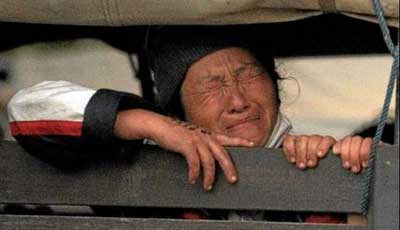
An Ethnic Hmong refugee sits inside a police truck during the operation to deport thousands of Hmong to Laos near the ethnic Hmong refugee camp in Huay Nam Khao in northern Phetchabun province in December 2009. (File photo by Pornchai Kittiwongsakul/AFP/Getty Images)
Selling fried chicken on the streets for about $4 a day, she does her best to care for and protect her 5-year-old daughter.
A Hmong immigrant from Laos, Vang learned to hide from vengeful authorities as a child, because decades ago her ancestors were armed by the US to fight against communists during the Vietnam War.
Since the war ended, the US had resettled more than 253,000 persecuted Hmong refugees like Vang, who typically sought asylum through camps set up in Thailand. Some Laotian authorities persist at seeing Hmong as conspirators for the US, harassing and tormenting them.
“The Lao government continues to view the Hmong with suspicion and in some cases outright hostility, and are inclined to believe the worst about them,” Deputy Director Phil Robertson for Human Rights Watch in Bangkok wrote in an email.
Representatives of the Laotian government did not respond to GlobalPost’s requests for comment.
In 2009, the Thai government stopped hosting the refugees in an effort to improve diplomatic relations with Laos. Authorities destroyed the remaining camps and deported about 4,500 Hmong, including Vang and her 1-month-old daughter.
Vang is among the thousands of forgotten Lao Hmong who have lived in this grim limbo since, either ducking attention in their homeland because of the danger there, or living in the shadows in Thailand, in fear of deportation.
When she was deported from Thailand in 2009, Vang was already an experienced migrant.
She first fled Laos around 2005, as a pre-adolescent with her adoptive mother after her father died from illness. She was arrested soon after and returned with 26 other children. Upon crossing the border, Laotian police singled her out, she said, because she shared the surname of a general who commanded the secret Hmong army in the 70s. She says she was nearly interrogated to death.
“They kept telling me I was a spy for the US, but I wasn’t,” said Vang in broken Thai. Crying, she recounted waking up naked in an isolated room after being starved and beaten for several days. “I was sure they were going to kill me.”
After about two months of incarceration she and the other children were released. Vang had lost contact with her mom, so in fear of the Laotian police she made another dash across the Mekong River to Thailand, where she remains today, scraping by, worried her daughter will not be able to go to school.
A refugee director at the US Department of State says there are two avenues into the country for people like Vang. One is to trudge to America on her own and apply for asylum once she’s there. The other would be to acquire a reference from the United Nations High Commission of Refugees (UNHCR) based in Bangkok. However, that’s the same agency that Vang says has ignored her case and many others’ since the 2009 deportations.
Read the full article by Kamala Kelkar from Global Post.