By GWEN PEARSON, Wired
The newly described stick insect Phryganistria heusii yentuensis is over a foot long (32cm), or 21 inches (54 cm) with its front legs stretched out. It’s the second biggest living insect that has been described. Ever.
Entomologist Joachim Bresseel holding a female Phryganistria heusii yentuensis. At 32 centimetres long, it’s the second largest insect species on earth (54 cm with legs stretched out) Bresseel & Constant, Royal Belgian Institute of Natural Sciences
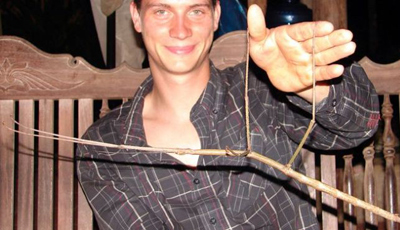
Walking sticks are a group of leaf-eating insects that look like … well, sticks and twigs. They are not easy animals to spot. Researchers from the Royal Belgian Institute of Natural Sciences (RBINS) captured the new species in Vietnam.
Catching and studying walking sticks is not easy, since they are mostly active at night. And by “active,” please understand I mean lumbering along slowly while pretending to be branches swaying in the breeze.
The new walking stick species were found using a classic entomological technique: beating. It involves a really large stick and a bed sheet. You put the sheet on the ground and whack a bush with your stick. Many insects release their grip and play dead when disturbed, and so drop onto your sheet for easy retrieval.
Alas, the researchers haven’t responded to my inquiry about what words they said (or at what volume) when these huge insects flopped out of the undergrowth. I suspect some rather strong language was used.
It’s Harder to Tell Sticks Apart Than You Think
Stick insects have sexual dimorphism, a fancy way of saying males and females differ remarkably in size and color. Female stick insects are large compared to males; it’s not uncommon for females to be twice the size of males.
The research wasn’t just collecting new insects; old preserved specimens were also examined. Specimens (and their confusing, hand-written labels from 100 years ago in a variety of languages) from museums in Russia, China, the US, and other spots around the globe were examined.
Because the sexes vary so much, and there are lots of big sticky things in Asian forests, early collectors tended to name each new big bug they found as a new species. The researchers tried to figure out which specimens actually belong to the same species.
Read the full article HERE.