By Charles Lam, OC Weekly
No one gave Maxwell Chorak a second thought as he got off at one of the bus stops near UC Irvine and walked across campus on June 10, 2014. He resembled a disheveled grad student checking in for an evening of studying, blending neatly with the thin crowds that walked on a near-lifeless Ring Road. The footpath, normally lined with students selling $2 boba and spam musubi, was nearly abandoned that day as students prepared for their finals.
The structure where Chorak took his life. (Dustin Ames/OC Weekly)
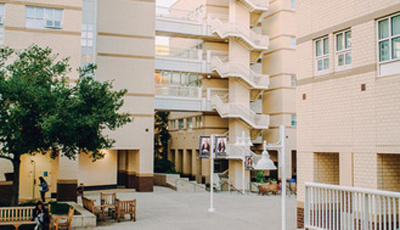
Chorak headed for Social Science Plaza, a collection of five-story buildings all Anteaters must pass through at some point in their academic career. They stand in an uneven, irregular courtyard, with a fountain that’s always turned off nowadays in an effort to save water. The 25-year-old climbed one of the plaza’s exterior stairwells, a spiral of steps coiling its way up to the top; mult iple warning signs are bolted to the stone walls at each landing. “We can help,” the signs read in a relaxed, sans-serif font, and feature the number for the National Suicide Prevention Lifeline.
Everything about the scene, from the signs’ typography and rounded edges to the stairwell’s cream-white tone, seemed designed to calm anyone. From his vantage point, Chorak saw a courtyard next to Social Science Plaza emptier than usual. It was the last week of classes for that school year, and students were either in lectures or taking tests.
It was warm and quiet as Chorak reached one of the higher tiers of the stairwell and leaped. There was no final scream, no note left behind.
Students saw Chorak as he fell and immediately called 911. UCI’s campus police arrived moments later, declaring him dead at the scene. Already primed for tragedy after a late-May shooting rampage at UC Santa Barbara, school administrators quickly closed off the area, drawing a far-reaching perimeter to keep students away from the tarp covering Chorak’s body. Counseling was made available on the scene for anyone who needed it.
After some investigation–who was he, could he have been pushed, why was he even at the university–the Orange County coroner removed Chorak’s body. The following day, UCI issued a statement that he wasn’t affiliated with the university and no one knew why he was even there.
But, under the plainest understanding of the word affiliated, that statement was not true. Chorak had been released roughly three hours before he died from the UCI Medical Center in Orange. He had been held there for 11 days to undergo examination under California’s Lanterman-Petris-Short Act, a set of laws that did away with state mental institutions in the 1960s but allows for individuals to be held against their will for treatment if they’re a danger to themselves or others.
Physicians gave Chorak a bus voucher upon his release; he left the hospital only with the clothes on his back. He had actually spent much time on campus, and he knew exactly where to jump: Social Science Plaza, the place that distraught UCI students and visitors have turned into a macabre monument.
Read the full article HERE.