By Alix Spiegel, NPR
It’s a tradition as old as New Year’s: making resolutions. We will not smoke, or sojourn with the bucket of mint chocolate chip. In fact, we will resist sweets generally, including the bowl of M&M’s that our co-worker has helpfully positioned on the aisle corner of his desk. There will be exercise, and the learning of a new language.
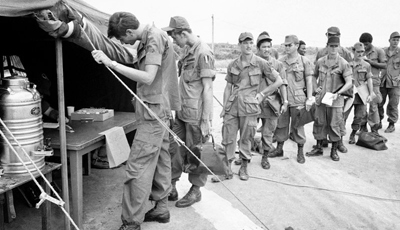
U.S. soldiers at Long Binh base in South Vietnam line up to give urine samples at a heroin detection center before departing for the United States. About 20 percent of soldiers said they were addicts, but most didn’t continue drug use back home. AP
It is resolved.
So what does science know about translating our resolve into actual changes in behavior? The answer to this question brings us — strangely enough — to a story about heroin use in Vietnam.
In May of 1971, two congressmen, Robert Steele from Connecticut and Morgan Murphy of Illinois, went to Vietnam for an official visit and returned with some extremely disturbing news: 15 percent of U.S. servicemen in Vietnam, they said, were actively addicted to heroin.
The idea that so many servicemen were addicted to heroin horrified the public. At that point heroin was the bete noire of American drugs. It was thought to be the most addictive substance ever produced, a narcotic so powerful that once addiction claimed you, it was nearly impossible to escape.
In response to this report, President Richard Nixon took action. In June of 1971, he announced that he was creating a whole new office — the Special Action Office of Drug Abuse Prevention — dedicated to fighting the evil of drugs. He laid out a program of prevention and rehabilitation, but there was something else Nixon wanted: He wanted to find out what happened to the addicted servicemen once they returned home.
And so Jerome Jaffe, whom Nixon had appointed to run the new office, contacted a well-respected psychiatric researcher named Lee Robins and asked her to help with the study. He promised her unprecedented access to enlisted men in the Army so that she could get the job done.
Soon a comprehensive system was set up so that every enlisted man was tested for heroin addiction before he was allowed to return home. And in this population, Robins did find high rates of addiction: Around 20 percent of the soldiers self-identified as addicts.
Those who were addicted were kept in Vietnam until they dried out. When these soldiers finally did return to their lives back in the U.S., Robins tracked them, collecting data at regular intervals. And this is where the story takes a curious turn: According to her research, the number of soldiers who continued their heroin addiction once they returned to the U.S. was shockingly low.
“I believe the number of people who actually relapsed to heroin use in the first year was about 5 percent,” Jaffe said in 2011. In other words, 95 percent of the people who were addicted in Vietnam did not become re-addicted when they returned to the United States.
This flew in the face of everything everyone knew both about heroin and about drug addiction generally. When addicts were treated in the U.S. and returned to their homes, relapse rates hovered around 90 percent. It didn’t make sense.
“Everyone thought there was somehow she was lying, or she did something wrong, or she was politically influenced,” Jaffe says. “She spent months, if not years, trying to defend the integrity of the study.”
But 40 years later, the findings of this study are widely accepted. To explain why, you need to understand how the science of behavior change has itself changed.
According to Wendy Wood, a professor of psychology at the University of Southern California who researches behavior change, in the 1960s, 1970s and 1980s scientists thought that if you wanted to change behavior, the key was to change people’s goals and intentions.
“The research was very much focused on trying to understand how to change people’s attitudes,” Wood says, “with the assumption that behavior change would just follow.”
So researchers studied how to organize public health campaigns, or how to use social pressure to change attitudes. And, says David Neal, another psychologist who looks at behavior change, these strategies did work. “They do work for a certain subset of behaviors,” he says. “They work for behaviors that people don’t perform too frequently.”
If you want, for example, to increase the number of people who donate blood, a public campaign can work well. But if you want them to quit smoking, campaigns intended to change attitudes are often less effective.
“Once a behavior had been repeated a lot, especially if the person does it in the same setting, you can successfully change what people want to do. But if they’ve done it enough, their behavior doesn’t follow their intentions,” Neal explains.
Read the full article HERE.