President Barack Obama has announced the US is fully lifting its embargo on sales of lethal weapons to Vietnam, its one-time enemy. Speaking during a visit to communist Vietnam and talks with its leaders, Obama said the move removed a “lingering vestige of the Cold War”.
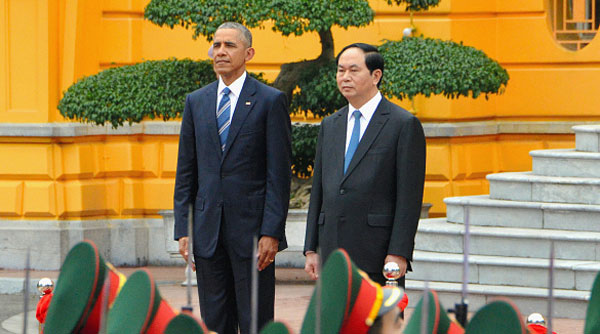
U.S. President Barack Obama (L) and Vietnamese President Tran Dai Quang (R) attend the welcome ceremony at the Presidential Palace on May 23, 2016 in Hanoi, Vietnam. Obama is on tour to Vietnam and Japan. (Photo by The Asahi Shimbun via Getty Images)
The US is trying to bolster its relationship with its Pacific allies, as China asserts territorial claims. But Obama said the embargo decision was not related to US policy on China. Vietnam is one of several countries in the region involved in maritime disputes with China. The US insists on the right to freedom of navigation in the South China Sea.
In 2014, a row over a Chinese oil rig near the Paracel islands led to clashes between Chinese and Vietnamese vessels and anti-China riots in Vietnam.
“Sales will need to still meet strict requirements, including those related to human rights, but this change will ensure that Vietnam has access to the equipment it needs to defend itself,” Obama said after talks with President Tran Dai Quang.
Vietnam had been arguing for an end to the embargo, which was partially lifted in 2014.
President Obama’s easing of all remaining restrictions on arms sales to Vietnam is powerfully symbolic. But what does it mean in practice?
Up to now, Vietnam has relied on Russia to supply most of its defense equipment, a legacy of the Cold War, when they were allies. The government would certainly like to diversify its sources, and is looking at a number of potential alternative suppliers. But it won’t be rushing into the arms of US manufacturers just yet.
One reason is that a lot of US technology may be too sophisticated and expensive for Vietnam’s needs. And while Vietnam’s defense spending, which has doubled over the past decade, is driven by the rivalry with its giant neighbor China, it will not want to antagonize China by seeking state-of-the-art US weapons that might alter the military balance.
Another reason is the complicated process of procuring US weapons. In his announcement, Obama said any military contracts would still be subject to provisos on human rights, and given the Vietnamese government’s poor human rights record that might hold up possible arms sales in Congress.
Obama’s visit comes 41 years after the end of the Vietnam War in which the US sought to prevent a communist takeover of South Vietnam.
To read more, click here: http://www.bbc.com/news/world-asia-36356695