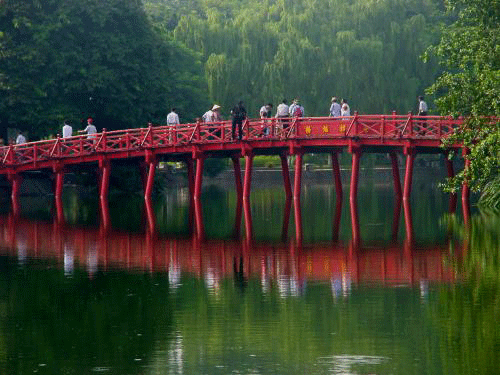
Photo courtesy of www.travelsense.asia
From
WIRE REPORTS
Aaron
Joel Santos has lived in Ha Noi for five years now.
If
5 1/2 years ago someone had told him he would have ended up living in Viet Nam,
the American documentary and travel photographer says he would have laughed.
He
had been living out of his car for a few months, travelling across his country.
He could not even have pointed out Viet Nam on a map then.
Yet,
on a whim, he left for that very country.
“I
moved to Viet Nam directly after attending photography school in Boston. I
thought I would live here for a few months, take some travel photos, and return
to the U.S. to start a photography career.”
But
when has life followed the script? Santos ended up living and pursuing a
photography career in Viet Nam.
“As
we all know, literature majors end up waiting tables,” he says tongue-in-cheek,
referring to the U.S. job market and his earlier literature and writing degree.
Wait
tables is what he did after graduation. He also was going to photography school
then.
“I
would have never been able to afford my first camera without my job as a
fine-dining waiter in Boston. “I also
wouldn’t have been able to afford my trip to Viet Nam without that job.”
Having
picked up his first camera pretty late in life, circa 2005, there is no
romantic story here about a kid who fell in love with pictures and went on to
become a successful photographer.
“I
achieved what I have achieved through hard work and long hours and a kind of
insane obsession with and fear of failure. Sometimes I felt like I was in the
right place at the right time.”
In
Ha Noi, he landed a job as host for a televised travel show for six months. At
various times he worked as a subeditor for several local English publications,
then as art director for a lifestyle magazine.
It
was a while before Santos became a full-time freelance photographer. He is now
represented by Novus Select in the U.S. and NOI Pictures in Southeast Asia. He
is also part of the agency roster at the Philadelphia-based Wonderful Machine.
His
works have been bought by The New York
Times, The International Herald
Tribune, The Wall Street
Journal and The Financial
Times, among others.
He
has set up Esian, a studio that shoots wedding photographs, while his works
have been exhibited in large gallery shows.
In Ha Noi
Santos
finds Ha Noi a great place to take pictures.
“One
of my favorite things about living in Ha Noi is the seemingly endless supply of
secrets it provides. After years here, I feel as if I have barely scratched the
surface of any and everything. And when I get called to photograph some
hitherto unknown location, well, that is always exciting.”
He
enjoys speaking English with those he meets.
“Try
to speak English to almost any Vietnamese kid and I bet you they know the words
‘hello’ and ‘beautiful’ or ‘handsome’.
“They
learn two words: one a greeting and the next a compliment. I’ve always enjoyed
that. It’s ridiculous and kind of amazing and I think it says a lot about the
place.”
It
is this kind of thing that started to grow on him, encouraging the newbie to
stay and make a name for himself in photography far away from home.
“It
almost felt like cheating, choosing to stay in Viet Nam. Not that the support
network here was or is any larger. But on a very basic level, I knew that it
would be easy to be poor and get by.
“I
would not have to wait tables and get burnt out while still trying to find time
to take pictures. I wouldn’t have to assist anyone. I wouldn’t need to live on
the outskirts of some major city for cheaper rent.”
He
is busy, traveling all over the country, around Southeast Asia, and the U.S.,
for photo assignments. Besides commercial work, he also works with NGOs for
social causes.
“I
am extremely happy with how I have grown as a photographer in the five years
since I moved to Viet Nam. [But] I still have doubts about this every month. Making
it as a professional is a difficult thing to assess. I have been lucky enough
to support myself solely through photography, so in the most simple of
definitions, I guess that I’ve ‘made it.’
“But
still, every month I kind of wonder how I got here, how I got so lucky. I think
this helps me to continue pushing myself forward.”
Love affair
Santos’s
literature and storytelling background seems to deeply influence his
photography. He loves documentary photography, telling a story.
“I
try to think of every image as a story, and every series of photographs as a
kind of narrative that can be deciphered in different ways.”
He
is also drawn to images that are emotional, though not necessarily overtly.
Often, the emotions in his works are beneath the surface, something that he
knows instinctively when he sees them in a subject, or, ideally, when he has
captured them.
“I
want people to see my photos as accessibly exotic, full of movement and
character and color and maybe this kind of simmering magic just under the
surface.
“I
hope people see my photos and then want to research more about the place or
subject I’m photographing. I want my photos to make people curious.”
Equally
important is to strive for balance. He says it is a constant struggle, either
between what clients want and creativity for the photographer himself or
following the beaten path.
His
favorite assignments are ones that take him outside major cities and into the
countryside in Viet Nam because, he says, there are so many facets to
Vietnamese life, and it is easy to forget about the distant villages in the
northern mountains or riverside towns in the Mekong Delta.
Since
he has had many memorable assignments, it is difficult for him to choose just
one as the “most memorable.”
“I try to never overlook the simple, quirky
things that make Viet Nam such a great place. I’ll never fully understand Viet
Nam, but that’s part of its magic.”