By Ralph Jennings, Christian Science Monitor
Saigon, VIETNAM — After anti-Chinese rioters attacked his auto-parts factory in May, Lee Wang-chung and his family had to leave town in a hurry. His factory was one of hundreds in Vietnam engulfed in protests triggered by popular fury at China’s positioning of a $1 billion oil rig in a disputed part of the South China Sea.
Smoke and flames billow from a factory window in Binh Duong on May 14, 2014, as anti-China protesters set more than a dozen factories on fire in Vietnam, according to state media, in an escalating backlash against Beijing’s deployment of an oil rig in contested waters. Workers looted goods and attacked offices in a rare outburst of public unrest on May 13 in the authoritarian communist nation, which allowed mass anti-China rallies around Vietnam at the weekend. (Photo credit should read VNExpress/AFP/Getty Images)
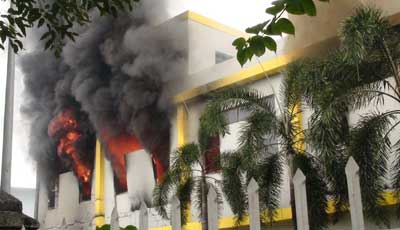
A week later, Mr. Lee was back at the factory, repairing its broken windows. He says the local government is supportive, as are his Vietnamese staff. For one thing, he’s not even a Chinese citizen: He’s Taiwanese.
But to the 20,000-odd rioters who rampaged through an industrial park looking for Chinese script or other symbols, that didn’t matter. Most of the 460 affected factories belonged to Taiwanese, Singaporeans, and South Koreans, whose companies have collectively poured billions of dollars into Vietnam’s rapid industrialization.
The question hanging over Vietnam is what happens next time there’s a provocation with China, its giant rival. While thousands of Chinese and other Asians fled Vietnam during the protests, investors and analysts say most have since returned after the government promised to ensure their safety. Police have arrested 85 people linked to the protests.
Having pledged to tamp down anti-Chinese violence, Vietnam may now opt for international diplomacy. Earlier this month, 61 members of the ruling Communist Party issued a public call for the government to take legal action against China over its oil rig deployment.
In the event of another high-seas face-off, Vietnam may appeal to a United Nations tribunal as the Philippines did March 30 over a separate bilateral maritime spat.
“Another similar China rig incident could well convince Hanoi that it needs to launch its own international tribunal case seeking arbitration over China’s claims,” says Murray Hiebert, senior fellow at the Center for Strategic and International Studies in Washington.
As a deterrent to China, Vietnam is asking the US to lift a longstanding ban on sales of lethal weapons. Japan and Russia have already pledged naval support to Vietnam.
Reliant on foreign capital
At the same time, Vietnam is stepping up policing of industrial parks with foreign-invested factories such as Lee’s, mindful that it depends on foreign capital to grow its $155 billion, export-dependent economy.
“The government when it feels threatened is able to step in, and one thing they don’t want is insecurity for foreign investment, because they rely heavily on [foreign investment] in this country,” says Ralf Matthaes, owner of In-Focus, a business consultancy in Saigon.
China has become Vietnam’s seventh largest investor with $2.3 billion in commitments in 2013, up from $345 million in 2012.
Read the full story by Ralph Jennings from Christian Science Monitor.