By Bill Briggs, NBC News
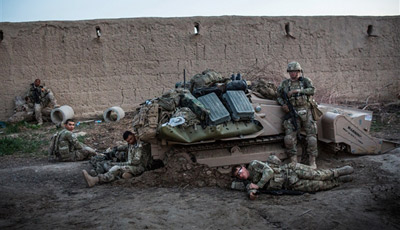
Soldiers with the United States Army’s 3rd Battalion, 41st Infantry Regiment, collapse at the end of the day, during a two-day joint mission with the Afghan National Civil Order Police. Andrew Burton / Getty Images
Veterans of the war in Afghanistan met the news that a draft security deal may continue the American presence in the country for years to come with echoes of military muddles past, worrying that a sustained U.S. force will only render a sandier, sunnier version of Korea, if not worse.
“I think Afghanistan has turned into the Vietnam of my generation, only with a better homecoming,” said Brandon Webb, a former Navy SEAL who served in that land during 2001 and 2002.
“We still have no definitive and clear strategic objective on the table. Have we made a difference? You only have to look at the country and assess whether it will be better off after we’ve pulled out completely. Only time will tell but I fear we’ve done more harm than good,” said Webb, editor of SOFREP.com, which covers U.S. Special Operations news.
Pulling out — what many Americans had expected in 2014 — appears wholly unlikely based on the draft of a pivotal U.S.-Afghan security deal obtained by NBC News . The document is a work in progress and is dated July 2013. According to that still-unsigned document, 2015 would mark the dawn of an open-ended presence by some 7,000 to 8,000 American troops who would operate bases to train Afghan forces and conduct counter-terrorism operations against al-Qaeda.
The working plan, shaped by hard negotiations from both governments and still subject to debate between village elders this week in Kabul, commits the U.S. military to “remain in force until the end of 2024 and beyond.”
“Did you say 2024?” asked Jeremy Hilton, a Navy veteran whose wife, Renae, an Air Force lieutenant colonel, served in Afghanistan. “We’ve already been there for over a decade. Our guys and gals shed so much blood over there, and you don’t want to simply pull out like we did with Iraq. We’ve seen the mess Iraq has turned into.
“But do we have the American public behind us [to stay another 10 years]? I just don’t see that we do,” added Hilton, who earned 2012 Military Spouse of the Year honors for his advocacy work. “For us to continue to use military force without the American public’s backing seems like a mistake.”
What size mistake?
“Look at Vietnam, for crying out loud. The military thankfully still has the public’s support,” said Hilton, who lives in Virginia. “I’m talking about the danger of losing that.”
Read the full article by Bill Briggs from NBC News.