By Joshua Keating, Slate
Hundreds of people have been arrested in what the New York Times calls the “worst public unrest in recent Vietnamese history,” as crowds ransacked more than a dozen foreign-owned factories in an industrial park near Saigon.
Smoke and flames billow from a factory window in Binh Duong on May 14, 2014, as anti-China protesters set more than a dozen factories on fire in Vietnam, according to state media, in an escalating backlash against Beijing’s deployment of an oil rig in contested waters. Workers looted goods and attacked offices in a rare outburst of public unrest on May 13 in the authoritarian communist nation, which allowed mass anti-China rallies around Vietnam at the weekend. (Photo VNExpress/AFP/Getty Images)
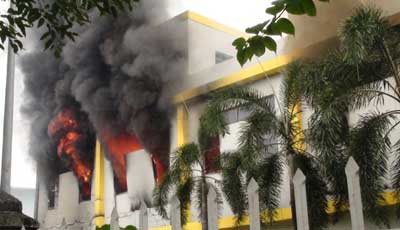
The riots were initially a protest against the mainland Chinese government, though a majority of the factories damaged were actually owned by Taiwanese or South Korean companies. To some extent they seem also to have been motivated by anger over working conditions and a lack of representation inVietnam’s authoritarian government.
China and Vietnam have been locked in a tense feud since the beginning of the month, when a Chinese oil rig was parked in the disputed Paracel Islands, which are claimed by both countries. The rig’s presence has led to clashes and collisions at sea and increasingly angry protests by the Vietnamese government.
As wages have risen in China in recent years, there’s been a shift of labor-intensive manufacturing to countries like Vietnam where wages are significantly lower. While China’s economic boom was once built on providing cheap manufacturing for Western companies, Chinese manufacturers have increasingly been moving their operations to Southeast Asian countries including Vietnam. Wages have been rising amid the country’s economic boom, but at about $100 a month, the average unskilled Vietnamese makes about a third of what a similar worker makes in China.
Read the full article by Joshua Keating from Slate.