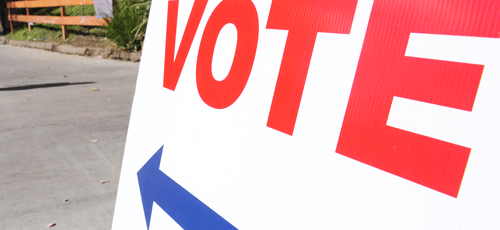
Photo courtesy of www.uci.edu
By ANTHONY ADVINCULA, New America Media
CHARLOTTE, N.C. — Asian Americans can be a force to reckon with only if a majority of them exercise their right to vote in the upcoming election, according to Asian elected officials at the Democratic National Convention.
Asian Americans are the fastest-growing minority group in the United States, but according to San Francisco Mayor Ed Lee, “We are still suffering from the 50 percent turnout as opposed to a bigger number of American voters.” Lee delivered his message at the Asian American and Pacific Islander (AAPI) Caucus at the convention. “We need to increase this turnout in our community, especially in this election.”
In 2008, only 48 percent of AAPI registered voters cast a ballot, according to the latest census data. This turnout made them the lowest registered group of voters as compared to 62 percent of all Americans.
Lee, the first Asian American to be elected as the city’s mayor, told the AAPI Caucus that Asian Americans — whether Vietnamese, Japanese, Pakistani, Indian, Indonesian, Filipinos or Chinese — should expand their participation in the political process and “talk more about the important issues that address the needs of the Asian community.”
“We need to keep our doors open to make our community more well represented,” he said.
Former Secretary of Transportation Norman Mineta concurred that if a majority of AAPI voters participated in the upcoming election, the group would have a significant impact.
The AAPI Caucus was attended by several high-ranking AAPI elected officials from different states and cities, including Sen. Daniel Inouye (D-Hawaii), Congressman Mike Honda (D-Calif.) and Congresswoman Judy Chu (D-Calif.). Jill Biden, the vice-president’s wife, and Maya Soetoro-Ng, President Obama’s half-sister, also delivered short remarks during the two-hour convening.
But Peter Leung, a Chinese American delegate from Oregon, was less adamant, admitting that AAPI votes are not crucial in U.S. elections.
“We don’t have that power yet — not in politics,” he said, sitting with fellow Asian delegates during the caucus. “And we can’t achieve that power through conversations like this.”
Despite a growing population, Asian Americans still have a “small voice in politics,” he said, and thus need a bigger platform to empower and help them engage in national political activities.
“Even at this convention, the Asian caucus is clearly empty as compared to the black and Latino caucuses,” Leung said. “I think Asians [did] not benefit from the Civil Rights movement. We care about science and technology, but not politics.”
_______________________________________________________________________________________________________________
Voter ID laws an extra challenge to Asian Americans
From ASIAN WEEK
In an election year where just a handful of votes could sway a tight election, some states are enacting laws to make it more difficult for citizens to vote. Voter identification laws have been passed or modified in 10 states since 2010 when Republicans made big gains in national politics through the Tea Party movement. Critics say these voter ID laws disproportionately affect voters who come from traditional minority communities.
Although much attention has been given to African American and Latino voters, these laws may have an even greater affect on Asian American voters. Pennsylvania’s new voter ID law is being challenged on just that idea. Due to the diversity of language, foreign name structure and customs, voter rolls are frequently fraught with clerical errors that could cause legally registered voters to be turned away at the polls.
The Asian American Legal Defense and Education Fund and the Asian Pacific American Bar Association of Pennsylvania are backing a lawsuit to block implementation of the Pennsylvanian new voter ID law. The groups filed an amicus brief to ask for reconsideration of an Aug. 15 ruling denying an injunction against the new law.
“Pennsylvania’s voter ID law disenfranchises Asian Americans and prevents racial and language minorities from exercising their fundamental right to vote,” said Margaret Fung, executive director of AALDEF.
Under Pennsylvania’s new voter ID law, all eligible voters must present government-issued photo identification in order to vote. If there are discrepancies between the name and format of the ID and the voter rolls, then the poll workers will have what the brief calls “unfettered discretion” in potentially preventing people from casting their vote.