ANNA CHALLET / NEW AMERICA MEDIA
Editor’s
note: New America Media editor Andrew Lam has made his name as a
journalist, but in his newest book, his past as a Vietnamese refugee
reverberates through short stories about characters who fled Viet Nam
and made new lives in the Bay Area. NAM reporter Anna Challet spoke
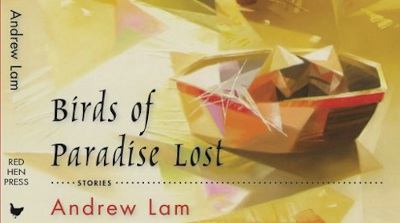
with him about the collection, “Birds
of Paradise Lost”
(Red Hen Press, 2013), published this month.
Anna
Challet: “Birds
of Paradise Lost” is your first book of fiction – how did you
come to publish a fiction collection after so many years of working
as a journalist?
Andrew
Lam: I’ve
been writing short stories for 20 years now, on and off ever since I
was in the creative writing program at San Francisco State
University. Though I later found a career as a journalist and an
essayist, fiction is my first love and I never left it, even though
there was no easy way to make a living from it. The collection is a
labor of love and devotion, and whenever I found free time from my
journalism work, I’d work on one story or another, or at least
sketch out my characters, and research various issues related to my
characters’ dilemmas. After 20 years and 30 stories, 13 pieces were
finally selected and the collection was born. So far, the blurbs from
[authors] Maxine Hong Kingston, Gish Jen, Robert Olen Butler, Oscar
Hijuelos and others have been most encouraging.
AC:
You’ve
written many personal essays and non-fiction pieces about coming to
the United States from Viet Nam. How does it feel to bring that
experience into the lives of your fictional characters?
AL:
Well, I always say that writing non-fiction versus writing fiction is
a bit like architecture versus abstract painting. In non-fiction you
have to stay true to historical events, be they personal or national
… In fiction, it’s as if you enter a dream world that you
created, but your characters have their own free will. They don’t
do what you want them to do – they get into trouble, do drugs,
fight over petty things and do outrageous things that you wouldn’t
want your children to do. In other words, you can only provide the
background, the seeds – in my case the background of the Vietnamese
refugee. When a well-rounded character takes over, he doesn’t
lecture you about his history and how he is misunderstood. He lives
his life, does things that are unexpected, and makes you laugh and
cry because of his human flaws and foibles.
AC:
How
did you come up with the title?
AL:
It’s the title of one of the 13 stories in the book, and it’s a
story that deals with death and hatred and self-immolation. In the
story, the narrator’s best friend commits self-immolation in
Washington, D.C., and leaves a note that says he hates the Vietnamese
communist regime and wants his death to call attention to communist
cruelty. But he also leaves his friends back in San Jose, California,
reeling from his death. Was it a patriotic act? A passing tourist
captures a picture of the man on fire, and the flame reminds the
narrator of the bird of paradise – both like a bird and a flame, a
phoenix of sorts.
AC:
English
is your third language, after Vietnamese and French. How is it that
you’ve come to write in English – your “stepmother tongue?”
AL:
You
know, I have a funny story to tell about English and how I came to
fall in love with the language. When I came to the United States in
1975 I was 11, and within a few months my voice broke. I was
desperate to fit in and spoke English all the time. Trouble was, in
my household it was a no-no to speak English because somehow it is
disrespectful to call parents and grandparents “you”; impersonal
pronouns are offensive in Vietnamese. But I couldn’t help it. I
recited commercials like a parrot and I got yelled at quite often. My
older brother one night said, “You speak so much English when
you’re not supposed to, that’s why your vocal chords shattered.
Now you sound like a duck.” I thought it was true. I went from this
sweet-voiced Vietnamese kid who spoke Vietnamese and French to this
craggy-voiced teenager. I thought, “Wow, English is like magic.”
It not only shattered my voice, it changed me physiologically. I
believed this for months … There’s magic in the language. I never
fell out of the enchantment.
AC:
Many
of the characters in your stories seem to be preoccupied with time –
telling the future (“The Palmist”), being unable to let go of the
past (“Bright Clouds Over the Mekong”), living in constant fear
of what surprise the present moment might bring (“Step Up and
Whistle”). Do you often find yourself writing about characters who
struggle in dealing with time?
AL:
I hadn’t thought of it in that way, but it’s true that the past
is ever present in the characters’ lives in “Birds of Paradise
Lost.” Perhaps it can’t be helped. So many of them either
experienced trauma – fleeing Viet Nam, watching someone be killed –
or inherited trauma from those who fled Viet Nam, that the past is
always flowing into the present. The future is of course the
possibility of an absolution, the possibility that they can conquer
this haunting aspect of the past so that they can begin to heal. Not
all of them do, of course, just like in real life.
AC:
What are your thoughts on being identified as a writer of immigrant
literature? Given that you’ve written so much about the Vietnamese
diaspora over the past 20 years, how do you think the concept of
immigrant literature is changing in the United States?
AL:
I think in a larger sense, immigrant narrative is comprehensive and
speaks to the core of human experience. Isn’t the first story told
in the West about the Fall? Adam and Eve were immigrants too from
somewhere, a lost Eden, a paradise lost. We all now are so mobile, so
nomadic … That experience of losing home, longing for home, that
yearning for meaning and rootedness and identity in a floating world,
it’s what often makes an immigrant story into an American story …
Today, more people are crossing various borders in order to survive,
thrive, change their lives. Even if you don’t cross the border,
with demographic shifts, the border sometimes crosses you …
America’s story is largely an immigrant story. That hasn’t
changed since the Pilgrims ate their first turkey some 400years ago,
and they were the original boat people.
AC:
As
an immigrant, what do you think of the current debate over
immigration in this country?
AL:
It’s unfortunate that the country of immigrants has turned its back
on immigrants. The atmosphere after 9/11 is toxic. In the war on
terrorism, the immigrant is often the scapegoat. He becomes a kind of
insurance policy against the effects of the recession. By blaming
him, the pressure valve is regulated in times of crisis … What we
have now is a public mindset of us versus them, and an overall
anti-immigrant climate that is both troubling and morally
reprehensible. Missing from the national conversation are voices of
pro-immigration reformers and civil rights leaders, who can speak on
behalf of those who have no voice. Where are the leaders who can
speak to the idea that it is not alien to American interests, but
very much in our socioeconomic interests – not to mention our
spiritual health – to integrate immigrants, that our nation
functions best when we welcome newcomers and help them participate
fully in our society?
I
am glad to see the wheels are moving at last toward comprehensive
immigration reform after last year’s election. I am glad that
immigrants are speaking up. I am hopeful that the pendulum swings
toward seeing immigrants in favorable terms once more.
All
three of my books, “Perfume
Dreams: Reflections on the Vietnamese Diaspora,”
“East
Eats West: Writing in Two Hemispheres”
and “Birds
of Paradise Lost”
are immigrant narratives – their dreams, their traumas, their
struggles – and I write them with the confidence that these
stories, written from the heart, will belong, in time, to America.
Andrew
Lam was recently interviewed by Michael Krasney on the National
Public Radio (NPR) program, Forum. To listen, click here.