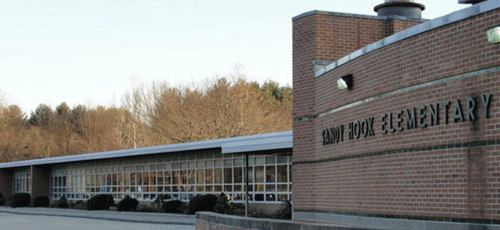
Photo courtesy of www.abcnews.go.com
By ANNA CHALLET,
New America Media
Editor’s
Note: The
Sandy Hook Elementary School shooting in Newtown, Conn., has renewed
national conversations about school safety and gun control. New
America Media spoke with investigative journalist Annette Fuentes,
the author of “Lockdown High: When the Schoolhouse Becomes the
Jailhouse” (Verso, 2011), about security in schools and how to
prevent another tragedy.
NAM:
There’s a growing perception that schools are unsafe. Will policing
schools solve the problem? Will we see more armed security guards and
surveillance systems in schools as a result of Newtown?
Annette
Fuentes:
It’s interesting that in Newtown the reporting indicates that the
school already had a large number of safeguards in place, such as
security cameras, a buzzer system at the front door and a serious
array of locks to keep intruders out. What trumped all of that was
the high-powered weaponry that Adam Lanza reportedly had and used to
burst into the school. So if someone has overwhelming firepower, some
of it military grade, nothing a school has will be able to prevent
them from doing damage and hurting people. So policing and armed
guards, even the idea that the NRA has floated of arming teachers and
the principal, really won’t prevent tragedies, and really will
increase the number of casualties. More policing and more security
hardware are certainly not the answer.
I’d
like to point out also that at Columbine High School, which I visited
for the ninth anniversary of the shooting, the school community
decided not to install metal detectors at the entrance to the school,
or really beef up the security much more than what they had at the
time of the 1999 shooting. And to this day, Columbine does not have
metal detectors at its doors, nor do they have armed guards at the
entrance.
NAM:
What makes for a safe school?
AF:
In
the research that I did for my book, I found that the ingredients for
a safe school certainly vary depending on the location. But
researchers in the field of academic achievement and school safety
and discipline have found that the existence of security hardware
like metal detectors, security cameras, policing, et cetera, actually
can create the kind of climate that increases the likelihood of
violence and disorder among students. In other words, if you treat
kids as if they’re potential criminals, and create a learning
environment that’s more prison-like, they’ll behave in a way that
reflects that expectation.
To
contrast, there’s a school that I profiled called the Urban Academy
on New York’s East Side. It’s an alternative public school for
students that did not like the traditional public school model. Many
of the students were considered perhaps difficult to manage. The
principal did away with metal detectors and some of the usual
policing technology that had existed at the school prior to his
arrival … He created an environment in the school of trust between
teachers, students, parents, and others in the community … It’s a
school that does have a security guard, but one who acts more as an
advisor and guidance counselor than as a police officer. The Urban
Academy model, that has no surveillance or security technology or
armed policing, has reported no guns or weapons taken from students
and no acts of violence, and has a very high percentage of kids
graduating and going off to college.
Safety
and security are conditions created by strong leadership that is in
control of the school and teachers in control of their classrooms,
who have received professional development, who understand the
dynamics of working with kids, and who do not resort to some of the
traditional strategies of discipline. It’s a completely different
paradigm.
NAM:
Why do you think people are targeting schools in mass shooting
incidents like this? What do you think is the root of this?
AF:
The
Newtown case is not a Columbine-type or Virginia Tech-type. The
gunman was not a student at the school. This was not an example of
school violence as people like to discuss school violence. We still
don’t know why Adam Lanza targeted this school. The reason that a
school can be a target is the reason a workplace can be a target;
there have been many workplace shootings … It’s important to
separate the location from the overriding condition of gun violence,
which can happen anywhere … The shooter was a young man with
problems; we don’t know what more there is to it. We don’t yet
know why he targeted this school. I’m concerned that people will
start talking about school violence, and that certainly isn’t
applicable in this case … I’m glad to see the public focusing on
the issue of gun control. Newtown is different from any of the other
mass shootings, and that includes the theater shooting in Aurora.
Newtown has put gun control on the front burner in an unprecedented
way, and that’s a good thing.
It’s
more than ironic that we have just learned that California’s
Teachers’ Retirement System had invested with the equity firm
Cerberus Capital Management, which owns Bushmaster [a firearms
maker]. In essence, the teachers’ retirement system owned part of
Bushmaster … The shooting is forcing everyone to look at the
business of guns and the dollars and cents behind the very powerful
gun lobby, because ultimately it is all about the dollars. When
people talk about school safety and school violence, it’s a way to
avoid talking about the real issue, which is the availability of
guns, especially semi-automatic guns, which are the real threat to
students.
NAM:
What do you think we should do going forward from Newtown?
AF:
I’m heartened that the national conversation in the last few days
has really focused on gun control. That is a major step forward from
mass shootings in the past. Gun control really is the only way to
prevent this kind of horror from happening again. At the same time,
it would be a mistake to put energy and resources into making public
schools into fortresses, squandering precious tax dollars and limited
school budgets on the technology and policing resources that people
think make schools and kids safer but that really don’t. The best
way to make schools safe is to create trusting learning environments.
Certainly an elementary school like Sandy Hook was purely a
vulnerable target that could only be made impenetrable with a barbed
wire fence or a concrete wall, but that is not the way to educate
kids. You can’t educate kids inside a prison. Whatever we finally
learn about Adam Lanza, no one could have been safe. He had these
weapons of mass destruction at his disposal, in his own home, and
that is the scariest part.