Hà Giang/Người Việt
Among the thousands of April 1975 stories, perhaps the most unusual one is that of a U.S. diplomat who disobeyed his superiors’ orders, throwing all caution to the wind, to fly to Vietnam in the final days of the war to help evacuate his wife’s family.
This is the story of David Brown, who was working at the U.S. Embassy in Tokyo at the time. Brown flew to Saigon in the last days of April to find a way to take his wife’s family out of Vietnam, even though he was prohibited to do so by both the U.S. Embassy in Tokyo and the U.S. Embassy in Saigon.
Tuyet and David Brown did not expect they would be sharing this story 40 years later. And the memory is something truly magical. Events that were deeply buried come rolling back with just a simple reminder.
***
On the night of April 27, 1975, only after he was seated among the members of his wife’s family on the plane, did David Brown dare to believe that he was safely leaving Vietnam. Thinking of his wife, Tuyet, anxiously awaiting news in Yokohama, he took out a pen and paper and started to write vigorously, trying to record everything that happened since they parted at Tokyo’s Haneda Airport.
“Now, if I can find that 16-page manuscript, maybe I’ll see that some details of what I am recalling are incorrect. But there are also things that you will never forget,” he began.
Soon after David and his fiancée, Tuyet, were married in Saigon in June 1969, the U.S. State Department transferred him from Vietnam to Washington. From Washington, he was sent to Japan. Such transfers are routine for American foreign service officers. In early 1975, David and Tuyet were attending Japanese language school in Yokohama, and their first child was less than a year old, the situation in Vietnam became increasingly tense.
 |
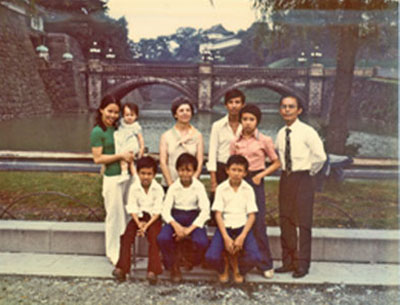
Tuyet Le Brown, (left) with her father (right) and five siblings in Tokyo, where her husband David Brown was stationed. This photo was taken outside the Imperial Palace. (Photo courtesy of David and Tuyet Brown) |
Tuning in the news from TV stations in Japan, they witnessed the defeat of the South Vietnamese army in different regions. Although letters from Tuyet’s family in Saigon conveyed her parents’ belief that the crisis would pass and Vietnam would stabilize, Tuyet and David knew that the information they had was more accurate. While watching the news at the dinner table one evening, they glanced at each other and realized the heart-wrenching and appalling truth: Saigon was falling into Communist hands.
“By mid-April, my wife and I were feverish with worry for her family,” David recalled. “Through a friend who worked at the U.S. Embassy in Tokyo, we learned that after a period of hesitation, the U.S. government was now seeking ways to bring families of the U.S. government employees and Vietnamese whose lives were considered to be at risk, out of Vietnam out as quickly as possible.”
From Tokyo to Saigon
The young couple feared that because Tuyet had married a U.S. Embassy political officer, her family in Vietnam would be in danger when the Communists took power. They worried also that her parents would not be financially able to arrange their evacuation in time.
“Tuyet yearned to return to Saigon to bring her parents, sisters and brothers out of Vietnam,” David said. “Her parents had written that they might not leave the country. They had only asked that we try to help her brothers and sisters evacuate.”
The two decided that David should be the one to go back. It would be hard for Tuyet to leave their infant daughter, and David would be better able to manage matters in Saigon.
Returning to Saigon then wasn’t a simple matter, however.
Continuing the story, Tuyet recalled that in the preceding weeks, David had many times been in touch with responsible people at the U.S. Embassy in Saigon and the State Department in Washington. He’d volunteered to go to Saigon to assist with the evacuation. He argued that as a fluent Vietnamese speaker, he could be especially useful there.
“No,” came the official reply. “You are absolutely not to go to Vietnam.”
The State Department assured him that “your wife’s family is on the list of people who are to be evacuated.”
Superior officers at the U.S. Embassy in Tokyo ordered David “not to do anything reckless.” He was told not to even think of returning to Vietnam at a time when the U.S. government was making every effort to bring people out of that country. The young couple discussed the situation from every angle.
At last they decided. David bought a ticket for a one-way journey to Saigon. On the morning of April 23, 1975, disregarding the order of both embassies, they parted at Haneda Airport with brave and tender words. David recalled changing planes in Hong Kong.
“The Air Vietnam flight to Saigon was nearly empty. It was dusk when it landed at Tan Son Nhat. I found a taxi to take me into the city, where I hoped I’d find a place to sleep.”
Twice, David learned that the friends he sought had already been evacuated. Then, just before the curfew hour, he found Charlie Coulter at the latter’s apartment. It was a lucky meeting, because Coulter was one of those who were helping to evacuate Vietnamese from Saigon. It was a stealthy business, operating in defiance of U.S. Ambassador Graham Martin’s order.
“The truth was,” David said, “that Ambassador Martin knew that this ‘underground railroad’ was operating very actively. He pretended not to be aware so as to sustain the morale of the South Vietnamese leaders.”
Last Nights in Saigon
David recalled that he hardly slept at all during that first night in Saigon. He and Coulter rose early to go to the embassy’s refugee operations command center. It was in a house not far away in District 3. When they arrived, another friend of David’s, Lacy Wright, was busy issuing letters authorizing the evacuation to the United States of people on a long list. Other embassy staff, mostly Vietnamese, would take the letters to the people on the list, and instruct them that they would be picked up at a certain secret meeting place at a certain time.
Once he clearly understood this procedure, David resolved to find a Vietnamese friend whom he could ask to help him get in touch with Tuyet’s family. Someone pointed out a number of the motorbikes parked outside on the lawn.
“You can use one for as long as you need it,” the person said, explaining that they belonged to people who’d already been evacuated. With this encouragement, David took a motorbike and headed for Phu Nhuan. After a bit of searching, he found Sự, a friend who’d worked with David in the 3rd Corps area eight years earlier. Sự had been a best man when David and Tuyet married.
“Even though Sự and I had a close relationship,” David said, “asking him for help at a time when he himself was really busy trying to arrange for his own family to leave Saigon was a bit much, I thought. However, Sự immediately agreed to deliver a letter to Tuyet’s parents at their flat in the An Quang apartment block.”
As David paused for a drink of water, Tuyet continued their story:
“Before David left Japan, I’d told him that under no circumstances should he himself go to find my parents. If he’d shown up there, but my parents continued to insist that they would not leave Vietnam, and if their neighbors at An Quang knew they had close ties to an American, it would surely have been dangerous for them afterward.”
“I had given David a letter,” Tuyet explained. “I asked him to guard it carefully. I wrote in the letter that David had come back to Vietnam to help those in the family who wished to evacuate, that they should prepare to go immediately, for there was no more time to hesitate! The letter said that after Saigon fell, life in Vietnam would be very difficult for everyone who had a close connection to Americans, like my family. The letter also entreated my father to allow my brothers and sisters to go, if he and my mother were determined to stay in Vietnam.”
|
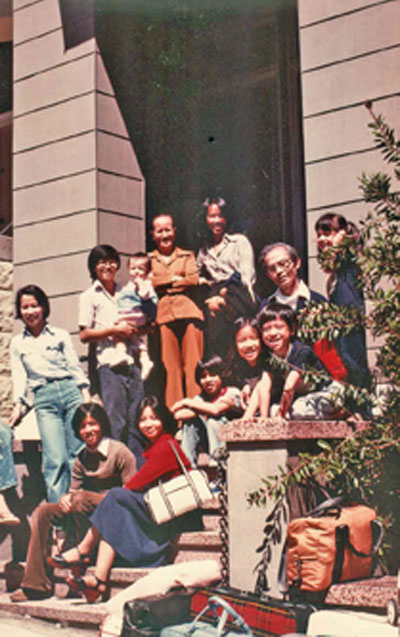
The family of Tuyet Le Brown in San Francisco, California after they resettled in 1978. (Photo courtesy of David and Tuyet Brown)
|
A few hours after his friend left to deliver Tuyet’s letter on the afternoon of April 24, Tuyet’s older sister, Lien, came to find David at the embassy evacuation command center. She was in something of a panic, David recalled. Her father and mother had agreed to evacuate, Lien said. The whole family would go except for their grandmother. Having delivered this news, Lien hesitantly asked David if it might be possible for him also to arrange for her husband’s family to leave with them.
Of course, there was only one answer David could give in that circumstance. Lien updated him on her situation: The airbase at Phu Cat in Binh Dinh province, where her husband was stationed, had been captured at the end of March. Her husband Thao was missing. Lien with her two toddlers had, with a great deal of difficulties, found their way, together with her husband’s family, from Danang to Saigon.
“Lien said that she’d come to meet me because her husband’s family had not found any way to leave Vietnam. And so, instead of asking for 12 letters of permission for family members to travel to the U.S., I needed to ask for 20!”
David continued that he had gone to the embassy evacuation team to ask if the extra eight relatives might go too. “It’s not a problem, we can take care of it,” said the officers working on the evacuation. They told him that two vans would pick up all the relatives at a certain place and time.
“I emphasized to Lien,” David said, “that no one was allowed more than one small suitcase, so everyone should use that space to carry things that could not be replaced in the U.S., for example, personal papers and photographs.”
After everything was arranged, David passed a couple of hours wandering the streets he knew well, thinking sadly of the changes that were sure to come. Saigon traffic seemed no different; the sidewalks were still zx full of pedestrians as ever. There was no sign of panic.
“Perhaps I knew of the hopelessness of the situation better than most of the people in the city,” David said. “But it is also possible that they were resigned to whatever was going to happen, as long as this endless war would be over.”
The pickup went smoothly at about noon on April 25.
“We were crammed into two vans with darkened windows. Our hearts were pounding when the vans halted at the Tan Son Nhut Airport gate, but after a perfunctory inspection, we were allowed to enter a big, fenced compound.
“We were taken to an eight-lane bowling alley in the US military advisory compound,” David continued. “It was already two-thirds full with refugees wearing worried expressions. (Ferdinand) Marcos, the Philippines president, had just issued an order forbidding the U.S. to evacuate people to Clark Field and Subic Bay. The airlift was halted until new destinations could be arranged. That night, we all slept right on a lane of the bowling alley.”
“The next morning, April 26, nothing had changed. To kill time, some of us found a way to unstop the overburdened toilets. Most people rested uneasily, however. It was as though time had stopped. At last, in the afternoon, the line began to move. They called the number of our group at about 9 p.m. The temporary evacuation permits were collected. My American passport was examined carefully, and then we were led out to buses that took us out to the flight line.”
“The hour to leave Vietnam had come.”
Leaving Vietnam
The airport was totally dark except that in the distance, a group of vans was delivering passengers and baggage to a brightly lit Boeing 747 with Air France markings. People whispered together that the 747 was evacuating President Thieu and South Vietnam’s gold reserves. Many years later, the rumor that many tons of gold left with Thieu turned out to be untrue.
A bit further off, a four engine C-141 waited. Its rear door was wide open. The plane was empty; every seat had been removed. David’s family climbed up into the belly of the plane together with about 200 other refugees.
“We were seated in rows about 20 abreast, and told to hold tightly to straps that crossed the floor of the airplane. Some airmen checked that everyone was seated properly, and then seated themselves on either side of the open cargo door. Just a few moments later, with all the lights extinguished, the C-141 taxied out to the runway. Tuyet’s little sister Tung, 14, and her youngest brother, Phuong, only 9, were on either side of me, each tightly gripping an arm.
And then the plane took off, climbing as steeply and as rapidly as possible to avoid becoming a tasty target for the North Vietnamese soldiers that might be digging in outside the airport.”
An hour later, when he could no longer bear sitting cross-legged on the deck of the C-141, David stood up and exercised his prerogative as the only blue-eyed passenger. An airman told him that the plane was headed for Guam.
“He gave me a nice place to sit, and I took out my pen and started a letter to Tuyet, relating all the details of what had happened since we parted at Haneda a few days earlier.”
On the morning of April 27, the airplane that evacuated David and his wife’s family from Vietnam landed at Anderson Air Force Base in Guam, the place from where the B-52 bombers had flown countless missions over Vietnam’s jungles. More waiting followed. A few hours later, David was allowed to make a phone call. When the phone rang at his little house in Yokohama — choked with emotion himself — he heard Tuyet’s happy sobs.
That afternoon, David and Tuyet’s family members were moved to the Orote Point camp, where a forest of tents was being erected. That’s where just a few days later, the refugees learned that Saigon had fallen.
Meanwhile, the U.S. government had issued orders for David to fly to Tokyo, bringing along Tuyet’s parents and her siblings under 21. Including David, that was eight people, while the rest of Tuyet’s family was taken to Camp Pendleton in Southern California. The little house in Yokohama was totally, warmly full.
As the airplane approached Tokyo, David at last had time to reflect on his disobedience. By ignoring orders not to go to Vietnam, surely he would be severely reprimanded. But, as it turned out, both officially and personally, the staff of the embassy from James Hodgson, ambassador to Japan, on down greeted him warmly and gave their full support.
“To this day, I can never forget the friendly gestures, the expressions of kindness from my co-workers and their families during those turbulent days,” David confided. “After I completed my Japanese culture and language training — and I have to admit that it was a struggle to finish all the requirements — Tuyet and I traveled with her family members to the U.S. to be reunited in San Francisco with those who had gone ahead. That was where everyone began their life as a refugee in the USA.”
And with that, the story of the evacuation of Tuyet Brown’s family ends.
————–
To contact the writer: [email protected]