Photo courtesy of www.guardian.co.uk
By ANDREW LAM, New America Media
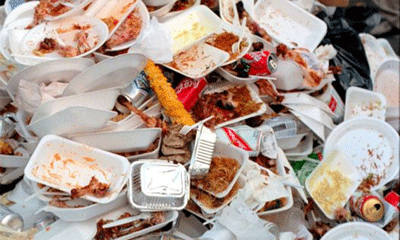
SAN FRANCISCO — When I was young, I used to eat food taken
from a supermarket’s garbage bin.
We
first came to America from Viet Nam in the mid-1970s as refugees, and my eldest
brother got a job working in a supermarket across from our apartment. Among his
many chores he found one particularly distasteful: throwing expired food into
the garbage bin nightly, then pouring Clorox on top to discourage scavengers
and the poor.
Without
fail he would call friends and relatives to come over in the dark of night and
salvage whatever we wanted before he poured the chemical over perfectly sealed
bags of cookies, frozen dinner trays, cans of tuna, bags of flour and a myriad
of other edible goods.
After
a while the supermarket manager caught on to this scheme and had a new trash
bin installed with a padlock. My brother was soon thereafter out of a job.
Going green, but wasting
Not much has changed since then as far as being wasteful
goes. In fact, it’s gotten worse. Sure Americans recycle. We talk green and
want to save the polar bears. But Americans still remain as wasteful as ever.
A
study by the Natural Resources Defense Council released
this week found that Americans “consume 10 times as much food as someone in
Southeast Asia, up 50 percent from Americans in the 1970s.”
We
are throwing away up to 40 percent of our food, the research finds. That is
estimated to be around $165 billion in wasted food each year. Even if we suffer
from a long, drawn-out recession, the average family of four winds up throwing
out as much as $2,200 worth of food a year.
Then
there are the side effects: Garbage production in the United States has doubled
in the past 30 years. Approximately 80 percent of U.S. products are used once
and thrown away, while 95 percent of all plastic, two-thirds of all glass
containers and 50 percent of all aluminum beverage cans are never recycled.
Instead they get burned or buried.
The
average American discards almost seven pounds of trash per day. Of all people
on earth we produce the most waste.
Planet garbage
The United States has less than 5 percent of the world’s
population, yet it consumes more than 30 percent of the world’s energy
resources and generates 70 percent of total global toxic waste.
“If
everyone on the planet consumed at U.S. rates, we would need three to five
planets to support our consumption,” states Global
Alliance for Incinerator Alternatives.
Not
long ago, frugality was a virtue. Now, two-thirds of our economy is based on
consumption. We live in the age of melting glaciers and rising sea levels, in
an age where polar bears drown, frogs die en masse, coral reefs disappear and
biodiversity dwindles along with forestland. We’re in the age, that is, of
global warming, where hurricanes ravage cities and towns; our way of life has
become unsustainable. It has created an unprecedented crisis on a planetary
scale.
“When
consumption becomes the very reason economies exist, we never ask, ‘How much is
enough?’ ‘Why do we need all this stuff?’ And, ‘Are we any happier?’” writes
David Suzuki, co-author of “The Sacred
Balance: Rediscovering Our Place in Nature.”
“Our
personal consumer choices have ecological, social and spiritual consequences,”
Suzuki writes. “It is time to re-examine some of our deeply held notions that
underlie our lifestyles.”
More
Americans are beginning to ask these same questions after Hurricane Katrina.
But materialism is a powerful force, and when elevated into a concept called
consumerism, refined by the genius of advertising and given a title ― “The American
Dream” ― few can resist.
Consumer
spending makes up more than 70 percent of our economy. We know we need to
change, but like many an overweight person who wants to diet and exercise, we,
as a nation, haven’t found the will to break the habit. And it doesn’t help
that we’re told all that consumption is good for the American economy.
As
it is garbage has become the legacy of our era. The largest human-made or
caused structures? It used to be the Great Wall of China. Today’s largest
man-caused structure is ― by far ― the Eastern Great Garbage Patch. That’s the
enormous swirl of plastics that gather in the gyrations of ocean currents
between California and Hawaii. Some scientists believe it to be the size of
Texas.
From refugees to ‘shop ‘til you drop’
Back in the 1970s, when my brother worked at the
supermarket, I remember hauling some of the market’s expired food home to my
family with giddiness. What Americans threw away was sustenance back home in
Viet Nam, where children scavenged through piles of garbage for anything
salvageable. People there canvassed the neighborhoods for old papers and
magazines to recycle or begged for slop to feed their pigs.
My
own family and relatives, too, have moved on from our humble beginnings as
refugees to become middle-class Americans whose motto, at times, seems to be “shop
‘til you drop.”
The
latest technology, the latest trend in fashion, the newest cars, the best
laptop, the latest iPads and iPhones ― we’ve got to have them all. And yes,
although I try to be frugal, I am part of that equation. I have thrown away
good food after a dinner party, have bought more than I can eat. I own the
latest technology. I am, too, part of the statistics.
Alas,
I am also aware that even as mainstream Americans are beginning to wonder if
our way of life has a direct consequence on the weather, everyone else wants to
become us. From China to Bombay, from Cape Town to Rio de Janeiro, everyone
wants a piece of the good life in the American style. Our collective desires
are putting more pressure on ecosystems already on the brink.
A
while back, walking home here in San Francisco, I saw two old Chinese ladies
looking for aluminum cans and plastic bottles in a garbage bin behind a
restaurant near my home. One of the workers came out and yelled at the old
ladies to stop.
As
I watched the two elders scurrying away into the shadows, I thought of my own
humble past. But I fear that, with the way things go, with global warming threatening
to undermine our civilization, those two old scavengers may well represent our
own retro-future.
Andrew
Lam is an editor with New America Media and the author of “Perfume Dreams: Reflections on the Vietnamese
Diaspora” (Heyday Books, 2005) and “East Eats West: Writing in Two Hemispheres.” His next book, “Birds of Paradise Lost,” is due out in
2013.