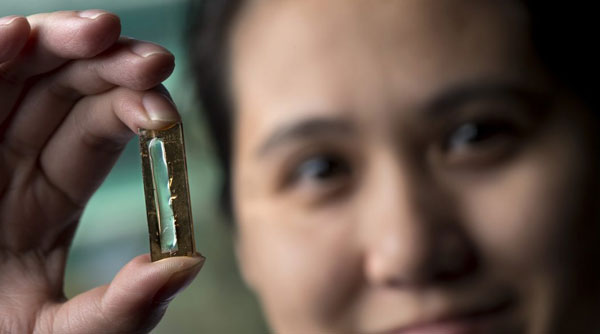
Ryan General/Next Shark Sometimes the best things in life happen by accident. Take the case of UCI doctoral candidate Mya Le Thai, who was reportedly playing around in the lab when she made a discovery that may have far reaching effects. Thai coated a set of gold nanowires in manganese dioxide before applying a “Plexiglas-like” electrolyte gel. UCI doctoral candidate Mya Le Thai has developed a nanowire-based technology that allows lithium-ion batteries to be recharged hundreds of thousands of times. Steve Zylius / UCI Nanowires, which are microscopic, ultra-thin and highly conductive fibers, normally die out after 8,000 charge cycles due to their fragile nature. However, the nanowires in Thai’s gel-coated battery remained intact after three months of tests. The researchers suspect that the gel caused the metal oxide in the battery to plasticize, providing its nanowires new-found flexibility and longevity. In the tests, the UCI nanobattery was able to endure up to 200,000 charge cycles “with 94–96% average Coulombic efficiency.” The battery was still rated as brand new by the end of the experiment. To put the new battery’s performance in better perspective, the average laptop battery has an average lifespan of 300 to 500 charge cycles with diminishing capacity at its top efficiency. With 1,000 cycles every two years, a laptop using UCI’s nanobattery would approximately last for 400 years. A previous record of 40,000 charge cycles was made by a nanobattery set in a different configuration developed by Stanford researchers in 2007. Applying such technology to commercial use could mean a huge revolution for electronics. To read more, click here: